
Favourite great hikes
— Including some penetrating busting of orthodoxies and received wisdoms
At a glance…
Here the Author shares a selection of his favourite great UK hikes, with various sometimes eyebrow-raising insights thrown in. The list of routes is followed by sections on related issues, generally holding various orthodoxies / urban myths up to experience-based rational scrutiny, but also including a section on hitch-hiking between his home in Exeter and various parts of the Cornwall coast, as hitch-hiking is normally his sole means of transport to and from his hiking routes.
Contents


Preliminary Notes

Take care!,
Do take it easy!,
Don't overdo anything!, and similar stupid utterances.
Photo: Mary Bagwell, 28 May 2022
Strong stuff!
I present here a simple, no-frills listing for enthusiasts. These are big, hard walks, in many cases much harder than their length on the map might suggest. So it would be wise not to commit yourself to any of these without proper research and preparation. The weather conditions on a few of my Dartmoor and Scottish mountain walks have made them potentially life-threatening and required a steady nerve and clear thinking for me get out without becoming an accident or even fatality statistic. You've been warned! …But the rewards that you can reap from going ahead are — shall we say? — out of this world…
Add to the adventure — hitch-hike!

Photo: Jon Zaple, 2 June 2022
The majority of these routes are notionally linear walks, which are much more satisfying than the circular walks that most people feel tied to in order to return to their cars. For the most part I get round the latter constraint by hitch-hiking out to the walk start and hitch-hiking back to base afterwards — often a very long and demanding day. This is relatively easy for me because I almost always go solo for my major walks, and I have no partner or family at home to go worrying about me if I have a lengthy delay for the return hitch-hike. One constraint that the hitch-hiking does place upon my routes is the choice of starting and finishing points, for only certain places are really workable for hitch-hiking.

Note that this ‘selfie’ shot makes me look peculiarly small because (a) the typical ‘selfie’ close wide-angle view gives a distorted perspective effect, and (b) I hadn't thought to stand fully on the verge as Jon was, so I look to be a few inches shorter than I really am!
Photo: Jon Zaple, 2 June 2022
Long, long days…
For my South-West England hikes I'd typically set out at about 6.40 to 7.0 in the morning after a filling breakfast, and can return home anything from 6.30 to 10.30 p.m. and just occasionally later. My record epic return was from Tintagel in 2007, when I didn't get back to my Exeter flat till 6.58 a.m. — something I'd be very happy never to have happen again!
In the most recent years I've actually been setting out an hour earlier, to increase my chances of having time for a full-length hike despite any vagaries of the outward hitch-hike.
Making the right signs — important!
For all hitch-hikes I use strong, well-made signs with the notional destination in thick black lettering on white paper on a piece of hardboard, with another sign the other way up on the other side, the lot sealed in with self-adhesive transparent film. These boards are of a shape and size which fits very conveniently inside the back of my rucksack (protected also by an old plastic carrier bag) so that they don't get bent or otherwise damaged while not in use. See here for notes on hitch-hiking between Exeter and far Cornwall. For all final destinations that are not reasonably well-known names to the majority of people, I start off showing a sign for a main location on the route that is reasonably well-known.
Thus for most places in far Cornwall I'd start off showing ‘PENZANCE’, and then change my sign accordingly further along, where I reckon enough people would know the place I'm aiming for. And for anywhere on the North Cornwall coastline from Polzeath to Crackington Haven I'd be showing ‘BODMIN’, but in that case I'd actually drop off just after Launceston, at Kennard's House junction, with my sign then showing my final destination.
In fact for many years now I've kept pack weight to a minimum by carrying only one board, which says EXETER one side and CITY CENTRE the other (the other way up). I'd need those on almost all outings. Then all the other signs are made in the same manner but without a board included in the self-adhesive film covering, so they're light and floppy. I then use a pair of spring-loaded paper clips at the top to hold the floppy sign in place over the EXETER sign — holding the board in such a way that my right hand lies over the near-side bottom corner of the floppy sign, so preventing it from flapping around except in really seriously windy conditions (when I normally wouldn't be going on such an outing anyway). It's thus my left hand that extends and ever-so-hopefully gives the thumb sign.
Ensure high visibility
Amazingly, and rather to my embarrassment in retrospect, it wasn't till 2010 that I started using a proper lightweight high-visibility bright yellow top garment on hitch-hikes — at least, when it wasn't too warm for me to wear one. And when it was too warm to wear it, I'd arrange it just under the rucksack lid in such a manner that it was poking out a bit either side and so helping make me more conspicuous that way.
More recently still I purchased through Amazon some quite broad elastic high visibility / reflective strips with Velcro at either end, which I was able to attach to certain points on my pack for each hitch-hike. Particularly helpful when actually walking along a road, as the pack would hide much of my high-visibility top from motorists approaching from behind.
It really does horrify me, looking back to before I was using proper high-viz gear, to realize the danger I was sometimes in, walking along roads in the dark. But quite apart from the safety aspect, since I started using high-viz gear even in broad daylight I've periodically had motorists tell me that they wouldn't have noticed me in time to stop for me, except for my ‘high-viz’, as they'd been driving too much on auto-pilot up to that point.
Indeed, on the odd occasion a motorist admits that they wouldn't have stopped for me except that at first they assumed I was some sort of traffic policeman seeking to pull them over — and then, on realizing I wasn't a policeman, had decided they might as well stop for me anyway.
So, high-viz definitely means not just increased safety but increased chances of getting picked up — all the more so as it also signifies, along with the well-made signs, that I'm a really purposeful and ‘professional’ hitch-hiker and thus am very likely to be a reliable and safe person to pick up.
However, except on the odd occasion where there is specific need for high visibility once out in the wilds, I put away all high-viz stuff for the hike (including the elastic strips on the pack), for it looks aggressive and inharmonious there when not specifically needed — spoiling the landscape for others as well as putting unnecessary wear on the high-viz gear.
Generally speaking, the only cause for me to go high-viz out in the wilds is when I'm doing natural soundscape recordings, and need to be on guard to shush approaching people on a nearby track — or, of course, during all-night sound recording sessions, when the high-viz can serve various purposes, including enabling me easily to return to my rucksack when I've been on my frequent walkabouts during the night, while recordings are running or I'm just waiting for dawn chorus time.
In times of COVID-19 high infection rates I adopted a policy of prudence and half-wore a face mask (i.e., had it on but not covering my mouth) while waiting for a lift or walking to where I was going to stand. As soon as a vehicle had stopped and I came up to the door / window, I adjusted the mask to its full-cover extent, as a signal to the driver that I intended to be as safe as possible for them. If a driver wanted me not to wear it, I told them that it was my firm policy to wear one out of respect to the safety of anyone else in the vehicle, regardless of whether or not they wanted me to, and I firmly did NOT engage with pandemic deniers or others who believed they knew better than me about that.
If anyone really objected or was persistently argumentative, I could always choose to ask (or, if necessary, to SHOUT at) them to stop somewhere safe and let me out, so I could travel with somebody harmonious instead of such twisted and indeed toxic fools.
And then an end to my major
hikes?
— Not bloody likely! (at least, at that point!) 
Nothing is permanent. Having upped the length of my hikes in August and September 2006 to my maximum again after a lessening in 2004, on a 21-mile hike from Mousehole to Cape Cornwall on 23rd September I got hit by an arthritic development in my right knee.
I assumed throughout the winter of 2006/7 that I'd not be doing long hikes again, and my doctor certainly thought so. I consoled myself by reminding myself that I'd had a good ‘run for my money’ considering the weakness I knew I'd always got in my knees and ankles, and undoubtedly without the Alexander Technique I'd have finished my hiking nearly 14 years sooner.
However, all wasn't lost. During the winter of 2006/7 I was restricted initially to a distinctly uncomfortable and rather fraught-feeling weekly 4-mile stroll on level ground from central Exeter down the river and canal to Double Locks and retrace, but then started extending to the Swing Bridge and retrace (making it a total of 5 miles). Then in early March 2007 I ‘broke through’ and walked the 8 miles down to Starcross without too serious objections from the gammy knee.
Since then my manageable mileage very slowly increased — this improvement accelerating after I took on a set of very powerful daily practices and measures for self-healing and rejuvenation in mid-May 2007, and has since been greatly reinforced by my further development of and expansion from those methods. The positive effect of these on my life (even in their rudimentary stage back then) has been dramatic.
On 24th July 2007 I walked the hard-going 14 miles on the Cornish coast path from St Keverne to Lizard Point. Then on 30th July I walked the very strenuous 18 miles on Cornish coast path from Polzeath to Tintagel, and on 4th August the also very strenuous 16 miles from Sidmouth to Lyme Regis. On 11th August — just two days before I officially became a pensioner (i.e., age 65) — I broke the 20-mile threshold in style, walking the 21 miles and over 1100 metres of ascent from Exmouth to Beer. In fact on that occasion there were about two miles of extra road walking in the outward hitch-hike, so my total for the day was about 23 miles.
Although it may look very impressive, that I'd effectively cured a major attack of what was diagnosed as osteoarthritis, there was actually a lot more to the situation, for that particular arthritis attack was actually little or nothing to do with normal ‘wear and tear’ osteoarthritis that you could blame on my age — even though my doctor believed it was just that, because neither he nor I at the time knew its true origin.
I did at the time, however, have a nagging suspicion that it might have been either caused or at least aggravated by weakening of my non-physical aspects by severe attacks from the garbage that I experienced especially in early September 2006, and that turned out to be sort-of correct, but through a bit of detective work in late 2008 I found that there was considerably more to it than just that.
It actually looks as though a very complex and potentially lethal psychic attack situation had been set up for me, culminating in a really weird hike on Dartmoor on 9th September 2006, and was responsible for that subsequent arthritic attack.
So, my healing of that arthritis wasn't so much a matter of reversal of normal ‘ageing’ — though a little bit of that could have been a factor — but more the healing of damage done to my non-physical aspects in that psychic attack.
I used a combination of methods, which were the embryonic vestiges of my current self-actualization methodology — see Philip Goddard's self-actualization methodology — Introduction.
So, clearly I was well back in business with the hiking outings. The tendency for slight nagging pains in that knee very gradually decreased (with little ups and downs) till it was hardly noticed at all, at least by 2008, and in any case my ‘reading’ since later in 2007 was that what pains I was still getting then were not arthritis at all but caused by another, much less serious weakness of that knee, which itself was very gradually improving.
… And, then in my 70s I was still doing it, including Tintagel to Polzeath and Exmouth to Beer, and still almost always being the overtaker rather than overtaken, at least as concerns other walkers. However, come my late 70s, and an accumulation of various health issues — mostly not age in itself, and starting with a weird virus infection in early 2018 — have caused a progressive slowing down and reduction of hiking endurance. Thus, at age 83 in 2025, I'm truly knackered by an 8-mile walk with a total of 440+ metres (with fairly heavy pack) and some long steep and uneven gradients (treacherous for weak ankles, and mine are indeed weak). I may be doing exceptionally well compared with a stereotypical 83-year-old, but that's not doing so well for me!
But then, my current understanding is that at some point soon I should move on from this planet and its dystopian human civilization for reincarnation a long time hence in some far-off ‘clean’ human-type planetary civilization, where I shall apparently have tasks to carry out as follow-up to my primary task of this lifetime, inconsiderately leaving behind a lump of carrion here for others to clear up and dispose of. — See My ‘lights-out’ time approaches….
The Hikes
Dartmoor — Devon, South-West England
Dartmoor in trouble — take a look…
Dartmoor: North section — 1

Tongue End (services) exit from the A30, near Okehampton – Belstone – Watchet Hill – Cullever Steps – Row Tor – (picking a line up the boulder field) – West Mill Tor – (direct approach via unofficial track) – Yes Tor – High Willhays (Southern England's highest point at 621 metres) – Fordsland Ledge – Kitty Tor – Green Tor – Bleak House – Chat Tor – Hare Tor (lunch stop) – (crossing Tavy Cleave at its steepest if conditions dry enough for stream crossing there – slippery rock to beware of) – Fur Tor – Cut Hill – Winney's Down (Statt's House) – Sittaford Tor – Fernworthy Forest (entering near Teignhead Farm – following the motor road near Fernworthy Reservoir and then a sharp right turn-off on a motor track, eventually to come out on the flank of White Ridge – top of White Ridge – Hartland Tor – Postbridge.
>>> c. 21 miles, with much very fatiguing and often boggy
terrain.
If wet and slippery rocks make the Tavy Cleave crossing impractical, the most secure place I've
found for the crossing of the River Tavy – good even when the streams are fairly high – is at the
upstream end of a bouldery area just downstream from Sandy Ford, which latter is the junction of
the Amicombe Brook with the Tavy. Rather than battle on upstream amongst the boulders to get there,
I go back up onto the higher ground and thus bypass a bend in the Tavy.
Please note that the very steep descent route I've been using into Tavy Cleave was getting overgrown by bracken and so was becoming rather impractical. Not only did the bracken make it difficult to see where to put one's feet on terrain that's tricky enough anyway, but the ticks on the bracken (with the risk of catching Lyme disease) had started to make it really a no-go for bare-legged monkeys like me.
Dartmoor: North section — 2

Tongue End (services) exit from the A30 – Belstone – Cosdon Hill – Hangingstone Hill – Taw Head – Black Hill – Cut Hill – Fur Tor (lunch stop) – Lynch Tor – Lich Way (followed not too slavishly in an easterly direction) – Lydford Tor – nearest of the Beardown Tors – Devonport Leat (follow this) – Beardown plantation – Beardown Farm – Two Bridges.
>>> c. 17 miles; similar terrain.
Dartmoor: South section

>>> c. 21 miles; similar terrain, though with mostly gentler gradients and less peat hags. Does that make it easier than the previous two routes? Well, actually for me it's even more fatiguing, because of the very tussocky nature of much of the terrain.
South-West Coast Path (South-West
Way)
– Devon and Cornwall, South-West England
South Devon coast: North-East from Exmouth

- including the top of High Peak, which used to make a marvellous early lunch stop, where I was usually sheltered when just sitting on the very top, even if a gale is blowing straight in off the sea. Unfortunately more recently it became very much overgrown with bracken, so I didn't normally bother to go up there, and, much more recently still, the mostly conifer plantation covering its summit area has been clear-felled, but without clearing the mass of bracken and bramble on top. There is now a clearer path to the top, but all you have is a viewpoint with nowhere decent to sit down or for more than a very few people even to be standing around.
- including the ancient hill fort earthworks above Branscombe village, known as the Branscombe Humps; this part is progressively becoming less negotiable as parts of the minor tracks there get overgrown with brambles and blackthorn scrub.
- from Branscombe Mouth, going straight up and following the top of Hooken Cliff and following the cliff edge closely for the views rather than following the track across the middle of a field. However, since my taking up the recording of natural soundscapes I've often preferred to follow the official coast path, through the Hooken undercliff and landslip area, for that has afforded many superior or indeed superlative recording opportunities.
>>> c. 21 miles from by Exmouth railway station, and very roughly 1,140 metres of ascent, but quite a lot of easy and fairly level walking between the steepish valley crossings, and the walk can be divided naturally into two or three shorter ones.
South Devon coast: South-West from Dawlish Warren
Dawlish Warren – Dawlish – Teignmouth – Shaldon – Torquay (following the coast path right round the limestone peninsula there)
>>> A major and hard walk, though a bit less so than the above route. Not such a regular for me because it doesn't take me so much away from civilization.
North Cornwall coast: From Bude: going South >> South-West

>>> c. 16 miles to Boscastle or close to 21 miles to Tintagel, with ascent totalling c. 2,000 metres for the latter option. Wild and rugged coastline with many quite spectacular stretches. A notoriously arduous walk, even the shorter option being distinctly harder than the 21-mile Exmouth to Beer route listed above.

North Cornwall >> Devon coast: From Bude: going North

>>> c. 14 miles to Hartland Quay and another 3 miles to Hartland Point, by which time I've accumulated some 1,400 metres of ascent. Another similarly notoriously arduous walk, but again the spectacular cliff scenery makes it all tremendously worthwhile.
North Cornwall coast: To Tintagel from the South-West:

>>> A very strenuous 17 miles with a similar amount of ascent to that of the previous two routes. The route can be divided into shorter sections, Port Isaac being the most obvious break point, but Port Quin and Trebarwith Strand also add to the options. The cliff scenery is consistently rugged and dramatic, and a particular feature of this stretch is the many, many abrupt small, narrow sea inlets bounded by sheer cliffs, often undercut into caves. Indeed, the coast path often passes over such undercut places, so in time in such places it will collapse into the sea.
To avoid disappointment, please be aware that Tintagel Island and the
so-called King Arthur's Castle ruins are privately owned, and a significant charge is made for
entry there – though this doesn't affect the coast path, which passes the island by. But in any
case – sour grapes aside – the ‘castle’ there almost certainly never saw King Arthur, because to
the best of my understanding he and all the legend surrounding him is myth, even though the story
would no doubt be based on various fragments of historical situations / events, not necessarily on
this planet or even universe!
Other wonderful options –
- Godrevy – Chapel Porth (extend it to Perranporth for a great 20-miler!)
- Portreath – Perranporth (St Agnes Beacon can be included, adding just 40–45 minutes to the walk even if one retraces to the departure point on the coast path.)
- Newquay – Porthcothan, Treyarnon or Trevose Head
- Porthoustock or St Keverne – Lizard Point (Some of this is as hard-going as the routes around the Land's End peninsula, and the serpentine rocks can be deadly slippery in wet conditions.)
- Poldhu Cove – Lizard Point, optionally continuing to Cadgwith
Join me on the Land's End peninsula…

Land's End peninsula, Cornwall: South >> West coast

>>> c. 14 miles from Mousehole to Sennen Cove, which may feel more like 20 because of the exceptionally hard-going nature of the track; this does ease, though, progressively after St Loy's cove, so that by the time you are at Gwennap Head you have mostly easy walking the rest of the way.Spectacular rugged granite cliff scenery which I now keep revisiting. There are many opportunities for exhilarating and secure scrambling and indeed full-blown rock climbing on the various granite crags, tors and buttresses.
The most wonderful option is to continue the walk to Cape Cornwall, making it 19 miles on the map from Mousehole (21.1 miles and 1396m of ascent according to the South-West Coast Path Association). But be warned, that even most strong walkers would feel they'd had enough for one day by the time they reached Sennen Cove. Take up the Alexander Technique to make your walking easier if you want to attempt such very hard options. With the help of that I've still been doing these crazy things in my 60s.

The fact of my being able to eliminate that medically diagnosed osteoarthritis completely very much supports my conclusions as to the cause of that particular arthritis outbreak. I'd be very unlikely indeed to be able to heal genuine age-related osteoarthritis — not being, nor aspiring to be, a magician or worker of ‘miracles’ (i.e., just more ‘magic’)!
Land's End peninsula, Cornwall: North >> West coast

>>> c. 16 miles, which again may feel like more than 20 for the same reason as for the above walk. Spectacular rugged granite cliff scenery that I nowadays keep revisiting. Many secure adventurous options for deviating slightly from the official coast path to scramble on some of the rock formations and get real gasp views. From by the Levant mine ruins round to Botallack Head the official coast path is relatively uninteresting apart from old tin mine ruins, and is worth deviating from to take a more adventurous route along the extremely rugged clifftop, with quite some feel of exposure and the odd small scramble. You can find out more about the multitude of mine ruins here.

Scottish Highlands
— Single days out from my one-time regular base at Fort William
Ben Nevis (the UK's highest mountain at 1,344 metres)

>>> Small distance on the map, but a major and quite serious walk with some of the views taking on what you could call a Wagnerian scale. This is THE finest ascent route of the Ben for walkers, but isn't for attempting if there's likely to be black ice on the arête or the general wind is blowing a gale (it's usually much stronger on the arête) — unless of course you're a bird lover and wish to become carrion to feed the ravens.
The arête, incidentally, isn't as formidably sharp and exposed as it looks from the summit of Carn Mor Dearg (especially in pictures), and, in fair, non-icy conditions it's just a matter of walking and the odd bits of very easy clambering on outcrops and boulders, often with little bits of track bypassing particular outcrops on the crest. In terms of the Arête's exposure, although a good head for heights is advisable, it isn't in the same league as Glencoe's Aonach Eagach for scrambling difficulty and exposure.
For a poem-story of mine that in fact describes this route, see The Man With Knobbly Knees.
Mamores: the ‘Ring of Steall’

>>> Again a small distance on the map, but a demanding walk with a lot of ascent, and the odd little bits of scrambling and exposure. The Mamores ridges are mostly more or less narrow, giving many dramatic profiles. The main scramble and indeed exposure comes on the brief but spectacular traverse of the top of An Garbhanach. The ascent route onto Sgurr a’ Mhaim that I give is my favourite for that mountain, and is far superior to the more direct and popular north-west ridge.

Mamores: Binnein Mor, plus, plus!

>>> A monster walk full of wonderful things. Binnein Mor, at 1,128 metres, is the highest of the Mamores summits. The total amount of ascent on this route approaches 2,000 metres, though if snow isn't an obstacle, a small track enables you to bypass Am Bodach on your left (the north side). A shorter alternative is, at Stob Coire a’ Chairn to follow the course of the previous route, over An Garbhanach / An Gearanach. Very strong winds, generally a safety problem on the high cols, can force one to miss out Binnein Mor's main summit.
Glencoe mountains: Bidean nam Bian

>>> Watch out — a serious warning for novices! This is an immensely spectacular but much more serious and potentially dangerous walk than most other mountain walks I've done. Bidean nam Bian is complex and craggy with various convex slopes and a plethora of precipitous buttresses, gullies and minor chasms, with many apparent descent routes that can get you into trouble. It's important to research routes on this mountain well, and, because you could be in the cloud at high levels, you need to be very sure of your descent route.
A good head for heights is essential. Unless you already know the descent route suggested above, it's best not to attempt that in the cloud, but to retrace from (or not go as far as) An t-Sron and descend instead very carefully into the very steep top of Coire nam Beith (the gradient soon eases and becomes more manageable), and the lie of the land there would guide you relatively safely down. Also be aware that in snowy conditions this mountain, and indeed presumably this corrie is prone to avalanches, depending on conditions.

Western Highlands: North Morar

>>> The walk looks short on the map but the rough and rugged terrain makes it seem much more. Sgurr Eireagoraidh* may be only some 548 metres in altitude (and thus getting few visitors), but it's craggy, and with a wonderful atmosphere, ‘personality’ and out-of-this-world summit panorama. The islands, and in particular, Skye, Rhum and Eigg, are prominent in the seaward view – the stuff of haunting memories!
* A pronunciation point. A local told me that Eireagoraidh is pronounced approximately Erégoré, where the é is pronounced as in French and the most stressed syllable is the second and the most unstressed the third — the latter having the typical ‘non-specific’ vowel sound that characterizes unstressed syllables in English.
I rarely managed to get an early hitch-hike out in this direction, so usually had to take the train for the outward journey, though would hitch-hike for the return.
WARNING: On one May evening when I was with a friend, a return hitch-hike from Glenfinnan on the Mallaig road (A830) actually failed, with the through traffic seemingly having dried up altogether, and we eventually had to call for a taxi to come from Fort William (thanks to a public telephone box there). Therefore, when I do the return hitch-hike on this road I make a point of being near a railway station and knowing the time of the last train to Fort William, just in case…
I would always choose a day with a lot of blue sky for this walk, for the fairyland that it explores presents water as sea, large lochs and nearer-at-hand lochans and pools appearing round almost every turning, every knoll. More than on any of my other walks, I'd always come away from this one in a state of ‘heavenly bliss’ — as though I had become the blue of sky / sea / lochs, and indeed the warm and glowing Sun.
Western Highlands: South Morar
Beasdale (station) – Sidhean Mor (ascended by its south-west ridge) – Druim Comhnard – Carn a’ Mhadaidh Ruadh – Bruach Bhuidhe – Sgurr an Albannaich – Sgurr an t-Sasunnaich – Arisaig (station)
>>> An absolute fairyland of remote, rough, craggy terrain made complex by all manner of little knolls and boggy patches. Although it starts and finishes at railway stations, this route is even more off the beaten track than the previous one, and its views almost as fine.
The summit of the long scarp of Sgurr an t-Sasunnaich makes a wonderful place to have a mid-afternoon eating stop, looking out over some low ground and then the sea to the islands and especially Skye. I have a particularly beautiful memory of sitting on that spot on one cool but sparkling May afternoon in 1995, watching long, gracefully curved pale streamers of hail falling from a shower cloud slowly moving away to Skye, with eventually a solitary lazy rumble of thunder rolling and booming around seemingly endlessly, as though taking all the time in the world to explore every nook and cranny of this paradise come true.
Please note the observation made about hitch-hiking for the Sgurr Eireagoraidh walk.
Western Highlands: Moidart — Rois-bheinn group
Lochailort – track skirting Tom Odhair – Druim Fiaclach (lunch stop), ascended via its north spur – Rois-bheinn (both tops) – descending (winding about) on the craggy north spur of the west top – Alisary Burn – Alisary – road walk or hitch-hike back to Lochailort.
>>> Another route whose main mountain doesn't reach the 3,000-feet altitude that would attract the hordes. Blissful solitude and tremendous views out to the islands, with mostly quite easy high-level walking as far as wild mountains go, apart from the rather soggy and soft lower part of the initial ascent.
Please note the observation made about hitch-hiking for the Sgurr Eireagoraidh walk.
Hearing voices on Rois-bheinn — a REAL ghost!
Have you heard seemingly inexplicable distant voices while ascending from the Bealach an Fhiona (after Sgurr na Ba Glaise) onto Rois-bheinn's east summit? I myself heard them each time I was there, and somebody else has reported to me the same phenomenon there. The voices seemed to be back in the col, and would stop every time I stopped and turned round to look for the source of the voices. They were too distant for me ever to make out what they were saying, but they sounded like two or perhaps three people talking to each other (i.e., rather than anyone shouting out or trying to say anything to me).
Because other people have heard these voices there, it isn't likely to be just me being ‘peculiar’! My current ‘reading’ about this in retrospect (supported by a process of inner inquiry) is that almost certainly it was an actual ghost (note that I put this in the singular here), but ghosts are not what many people believe, for they are NOT discarnate human consciousnesses but elementals (a kind of geographically located thought form complex).
As I understand it, the particular ‘voices’ manifestation here was really caused by a ghost, which had unwittingly been created by one person who died probably sometime in the 1900s, before the 1980s (when I started visiting Rois-bheinn). That person had become so emotionally attached to that particular spot that when (s)he died this elemental was left there, containing a memory of that person with partner somewhere in that col, talking together as they were having an eating stop.*
* No, hang on a moment! — Actually, in late 2021 I worked out that that was an incorrect interpretation of the source of the particular ghost. There's a clear reason why the ghost couldn't have come from either of those two individuals. For a detailed explanation and the presumably correct interpretation please see the What a ghost really is.
I explain there also the most likely reason why you hear those voices only behind and well below you as you're ascending that particular slope, and why they seem to stop when you turn around to overlook the col.
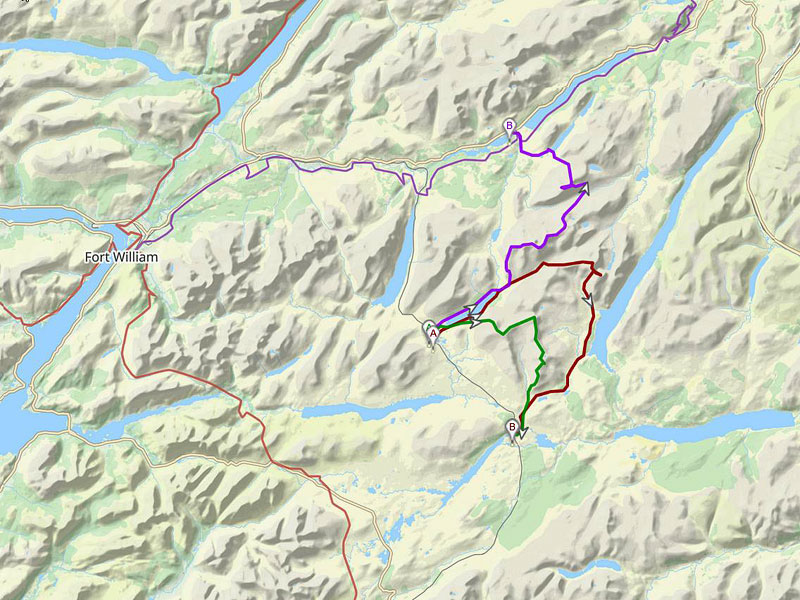
Starting point was Corrour station for all three (marker A, slightly misplaced for the Ben Alder route), and finishing point of the short route and Ben Alder one was Rannoch station (marker B).
Central Highlands: A Rannoch Moor gem

>>> Although remote, this route gives exceptionally easy high level walking and isn't all that long, so that with the very early and late trains involved I could really savour the unique and magical atmosphere and personality of this special place without worrying that I might miss the evening train. Probably the walk could be done as a route march to catch an earlier return train – a great idea if you like route marches!
Central Highlands: Alone across Rannoch Moor to Ben Alder
(Backdrop of the final movement of my Highland Wilderness (4th) Symphony)

>>> Warning! This is a very remote 23-mile walk, covering a lot of fatiguing rough peaty terrain a bit like Dartmoor, with little in the way of escape route. Unlike me, most people are ‘sensible’ and do this as a two-day, more leisurely walk, camping overnight. The high level part of the walk is actually easy in good conditions, apart from a little care required for the steep descent to Bealach Breabag, but conditions can be ruthlessly windy and cold on the extensive Ben Alder plateau, and it's very easy to get disoriented there in cloud, so it's still a ‘serious’ mountain to go on.
For an inspirational account of my first walking that route, complete with detailed context, please see My audacious Ben Alder adventure.
Central Highlands: The mountains north-west of Ben Alder
>>> 20 miles and some 1,570 metres of ascent, in very remote terrain. Once you've come out at the main road at the end, it's a further 6 miles along that road to Tulloch station if you want to catch a train then. This road normally has light traffic and can be difficult for hitch-hiking, but since the road improvement some years ago the traffic seems to have picked up a little, and I always managed to hitch-hike back to Fort William in reasonable (sometimes very good) time after this walk. For safety, though, I start walking along the road towards Tulloch, signalling as I go, just in case…
For descent from Geal Charn I especially recommend the very steep and rather craggy north-east spur if conditions are good, for it commands a particularly wonderful view, with steep drops to a lochan on either side. Likewise, for the ascent of Beinn a’ Chlachair I recommend the easy scramble nearing the top of the spur you get onto, rather than rounding it into the upper corrie and then taking an easy slope (plod, plod…).
For an inspirational account of my first walking that route (as a ‘dress rehearsal’ for my really adventurous single-day Ben Alder hike), complete with detailed context, please see My audacious Ben Alder adventure.
Central Highlands: Black Mount group
The A82 near Kingshouse – Sron na Creise via its north spur – Creise – Clach Leathad – Bealach Fuar-chathaidh – Aonach Mor – Stob Ghabhar – Aonach Eagach (the name wrongly positioned on some maps) – down the latter's very steep NE spur (needs much care – a lot of loose stuff!) – Stob a’ Choire Odhair – Beinn Toaig – (descending on the latter's NE spur) – West Highland Way – peaty track turning off to right just after Bà Cottage ruin – A82 near Loch Bà.
>>> c. 15 miles and 1,740 metres of ascent. A ‘killer’ walk with a sense of breathtaking scale and grand views over Rannoch Moor. I've stood on Stob Ghabhar and been crying, I was so moved by the view, which felt to me to be some sort of homeland. From afar, the initial ascent of Sron na Creise looks impossible as a walking route, but with careful winding about and picking good lines you need only a little minimal rock scrambling near the top of the steep work, and I suspect that even that can be rounded mostly on grass if you were really determined to avoid scrambling altogether.
The long, very steep descent to the Bealach Fuar-chathaidh is best not attempted in the cloud unless your compass work is really exemplary, because that low col can easily be missed in such conditions, then leading you into dangerous situations.
Central Highlands: Ben Starav plus!
Glen Etive (Coiletir) – (relentless steep slope) – Beinn Chaorach – Stob Coir’ an Albannaich (lunch stop) – Glas Bheinn Mhor – Meall nan Tri Tighearnan – Ben Starav – north-north-east spur – Coiletir.
>>> A tremendous sense of breathtaking scale on this very hard walk. The initial unremitting ascent has a rather punishing feel to it, but the reward is that you're relatively soon on the high level part of the walk. In late May or early June there can be fantastic displays of cushions of the pink-flowered Moss Campion on the summit plateau of Stob Coir’ an Albannaich, and the walking on that mountain is very pleasant underfoot, a very swift and safe descent being possible to the col before Glas Bheinn Mhor. Most people don't include Stob Coir’ an Albannaich in the same walk as Ben Starav.
Southern Highlands: Bridge of Orchy mountains

>>> c. 16 miles and some 1,827 metres of ascent — which is nominally more than the previous route, but is actually much less fatiguing because of the relatively easy high-level terrain. The views of this walk are dominated by the extremely beautiful and graceful glacier-carved shapes of these mountains. Again there are wonderful views out over Rannoch Moor.
North-West Highlands: Kintail area — The Saddle
Shiel Bridge – A’ Mhuing – Meallan Odhar – Forcan Ridge – The Saddle – following the craggy north-north-west ridge system to pick up a track in the col before Sgurr Mhic Bharraich – Shiel Bridge.
>>> A dramatic walk including (on the quite short Forcan Ridge) some of the most exposed scrambling you'd find on a walking route on the British mainland. The Forcan Ridge actually has a small hint of track bypassing most of the difficulties along the crest, but when I went up there I didn't have that option because old snow remnants rendered the bypass lines probably more dangerous than taking the crest route directly. Beyond the Forcan Ridge itself there's still a tricky little pitch to down-climb facing inwards (I needed somebody who'd gone down that to talk me through placing my feet safely), and some very narrow sections of the summit ridge with slight scrambles. Very exciting and for the most part very secure. If you're scared of heights, do yourself a favour and throw your phobia (but preferably not yourself) overboard here, and enjoy!
Note:
To get from Fort William to the Kintail area for a reasonable start time (9.0–9.30) I took the 7.28
a.m. Inverness bus to Invergarry and hitch-hiked from there, using a sign just saying KINTAIL. For
the return I simply hitch-hiked using my FORT WILLIAM sign and it always worked pretty
well.
On one occasion my return lift was in an empty hearse returning to Glasgow from a funeral just a little further west of where I'd placed myself. An enjoyable ride, with friendly and definitely not funereal company.
North-West Highlands: Kintail area — Beinn Fhada (Ben Attow) and Falls of Glomach
Morvich – Beinn Bhuidhe – Sgurr a’ Choire Ghairbh – Beinn Fhada – Coire an t-Siosalaich – Gleann Gaorsaic (east side, then west side) – Falls of Glomach – Bealach na Sroine – Strath Croe – main road near Morvich.
>>> This walk is demanding; to most people its route would represent two days' walks, even though the distance on the map doesn't look all that great. The broad summit plateau of Beinn Fhada can seem like an anticlimax after the marvellous craggy switchback of the ridge that leads onto it.
A note of caution: on that preliminary switchback is one small steep rock pitch, descent of which requires great care, and I've read warnings that in wet conditions the rock there is slippery, making that pitch virtually impassable except by dint of accident and probable injury.
The Falls of Glomach – and indeed the great ravine into which the water pours – comes as a most wonderful scenic shock.
Hitch-hiking
good and bad spots
between Exeter and far Cornwall
 This is just my own experience, so I make no guarantees as to anyone else's fortunes when
they're using the same hitch-hiking routes and pick-up points as I've been doing. Because of the
possibilities for long delays, I get up very early and aim to set out from my flat something in the
region of 7.0 a.m. or even a bit earlier if I can manage it (indeed, in 2016 I started usually
setting out before 6.0, even in winter). One thing I've learnt is, never to assume that because I
got a lift quickly on one occasion at a particular spot, it's therefore necessarily a generally
good place for the purpose.
This is just my own experience, so I make no guarantees as to anyone else's fortunes when
they're using the same hitch-hiking routes and pick-up points as I've been doing. Because of the
possibilities for long delays, I get up very early and aim to set out from my flat something in the
region of 7.0 a.m. or even a bit earlier if I can manage it (indeed, in 2016 I started usually
setting out before 6.0, even in winter). One thing I've learnt is, never to assume that because I
got a lift quickly on one occasion at a particular spot, it's therefore necessarily a generally
good place for the purpose.Exeter to Land's End peninsula (on the A30)
I show my sign along the way because then I sometimes get picked up before I reach the A30. However, it doesn't appear to be worthwhile to place myself and wait before having reached that point.
Although this is far from an ideal spot, it's the best that I've found for getting out on the A30 from Exeter. 20 minutes is a common waiting time, though it can be considerably more.
This used to be quite a good spot when it was just a roundabout here, but since the complete restructuring of this junction I'm not yet sure as I haven't used it much. It actually looks great, because of the generous hard and soft shoulder available for pulling in.
An initial quite long wait there jaundiced my perception of this junction a bit, but actually since then my waits here have been mostly relatively short, and, overall, this appears to be quite a good spot. It also has the advantage of the overpass, under which you could shelter from rain and still be fully visible to the traffic — a rare luxury on hitch-hiking spots!
Usable but in my experience not very good. Nowadays I aim to drop off at Whiddon down, because that's so much more inviting for people to stop, and my standing position there is very visible to approaching main carriageway traffic, whereas here the only way to be visible to approaching main traffic is to stand right beside the carriageway, which is both stressful and unsafe, and quite often prompts hostile hoots from passing cars.
 I did initially get a quick lift or two there, in the Bude direction, but generally it has
seemed to bear a jinx for my hitch-hiking in any direction, and I've learnt to avoid it like the
plague — except that I did try the Tavistock direction on a couple of occasions, and that worked
better.
I did initially get a quick lift or two there, in the Bude direction, but generally it has
seemed to bear a jinx for my hitch-hiking in any direction, and I've learnt to avoid it like the
plague — except that I did try the Tavistock direction on a couple of occasions, and that worked
better.
Usable, but in my experience not very good. The very strong bend in the slip road doesn't help.
What I'd been missing by using the latter junction when the particular motorist could have dropped me here! I discovered this as a really workable spot only in 2019/20. It gets a reasonable amount of slip road traffic, and by standing at the start of the long filter lane, which has space for pulling in, I'm visible to approaching main carriageway traffic for a reasonable distance.
This has usually worked reasonably on the few occasions when I've used it, but I have a gut feeling that it's basically not a very good junction for hitch-hiking.
When this junction was a big roundabout I managed tolerably well even though vehicles couldn't stop beyond the roundabout. Now that it's completely redesigned with fast through traffic and a long slip road and filter lane, it has been much better.
It doesn't look very promising for anyone to stop, but I've often had to use this one and I've rarely waited more than ½ hour there, and have more usually got a lift within five minutes. So I rate it as good. I refuse lift offers from here that don't go beyond Chiverton Cross (unless, of course, I'm aiming for Perranporth).
Since the building of the small slip road and filter lane on this side it has looked to be a
very bad place for anyone to stop. However, I had to use it a few times since that change and
didn't have to wait more than ½ hour. On the other hand, because it's basically a distinctly unsafe
place for motorists to stop, I avoid it nowadays if at all possible, not wishing to cause an
accident.
I have occasionally had to use either of these, and usually got away pretty soon. There was a fair amount of slip road traffic then (mid to late morning).
In the far past I used this junction and got away quickly, but in 2017 I got dropped there unexpectedly and I had an hour-plus wait with very little slip-road traffic. I'd be inclined to avoid this if possible.
Good. I've always got picked up at least within a fairly short time here.
For Penzance — I place myself a little beyond roundabout, at a spot where there's a minor turning, into which cars can pull in, or just a little further along towards the turning for St Erth railway station.
For St Ives — either just past the roundabout or walk on to a bit beyond the Lelant roundabout — or, as I usually do nowadays, place myself just in the left turning at the second roundabout, for going round the back way so I can be dropped at the top of St Ives.
For Penzance — Good. I've never waited long here.
For St Ives — Nowhere is a particularly good spot, though on occasions I've been picked
up quickly from just past the roundabout despite it looking very unpromising for anyone to stop
there. Generally I manage well enough, though. Just on the back-road turning (via Lelant Downs),
however, is really a poor place to stand, and a bit risky because nobody can see me until they're
just turning into this road, and they often swerve slightly to avoid me. Nonetheless, with me
wearing a high-visibility top and prepared to quickly step right back so as not to be knocked over,
it works quite well. 
Good. I've generally got picked up within a few minutes here, even though there is nowhere for vehicles to pull in.
I've got lifts here so far within 20 minutes, even though it isn't a good place for motorists to stop.
For taking the A30 Penzance bypass, I get onto the start of the bypass.
I did initially get lifts quickly or at least without too long a wait at this spot (i.e., on the start of the bypass), but it's really a very poor spot to expect motorists to stop, so nowadays I'm inclined to run the gauntlet of walking on along the bypass to just the other side of the Heamoor roundabout (some 15 minutes' really brisk walk), which has so far worked quite reasonably despite it not really being a good place for vehicles to stop.
However, that walk along the bypass is really quite unsafe, and to avoid that, nowadays I get myself dropped at the previous roundabout (Morrison's), aiming for a lift from there to Mousehole or other place beyond Penzance, or indeed to the Heamoor or Misery Mount roundabout on the bypass.
It feels chancy, with generally lighter traffic than further east, but has worked tolerably, for example, to Porthcurno or St Just, though quite often with some longish stretches of road walking, with resultant delays.
Branch Routes to…
Tends to be difficult, not least because the traffic is divided pretty well equally between several routes. Nowadays I choose to branch off at the first exit for Okehampton, waiting on the old A30 overpass there if necessary, aiming for Okehampton centre, then walking out (15 minutes unless picked up along the way) for the turning for Holsworthy. Good pick-up points along the way are Hallwill Junction (just round the bend), Dunsland Cross (where the road from Hatherleigh comes in), Holsworthy (by filling station) (excellent), Red Post Cross.
I aim towards Bude, branching off at Red Post Cross on the Kilkhampton road.
I start off with a Bodmin sign and branch off for the A395 at the Kennard's House junction just past Launceston, then using a sign for my actual destination. The best place for me to stand has been on the A395 just a bit beyond the roundabout, by the mouth of the slip road from the eastbound A30.
For Crackington Haven I turn off the A395 at Hallworthy, aiming for Wainhouse Corner on the A39, because that appears to be the best route for traffic likely to pick me up.
For the other places I aim to go left on the A39 when I reach it, and soon take the turning for the Slaughterbridge / Delabole road, which serves those places via connecting roads.
In the case of Polzeath, if I get somebody who is going to Wadebridge, I drop off at the mini-roundabout for the road towards Polzeath, and usually get a lift quickly from that turning.
Caution — for the most part I find the A395 and A39 difficult for getting lifts.I branch off at the Highgate Hill junction (for Newquay and Wadebridge), near Indian Queens. I've always got a lift pretty soon there.
I branch off at the first Portreath junction while passing Redruth, and walk (about 10 minutes) to get onto the Portreath road. I normally get a lift well within 20 minutes there. I fared poorly when trying the alternative signed route actually from the A30 junction, which is pointing towards Porthtowan. I found very little traffic going along there.
Land's End peninsula to Exeter
Start of the return hitch-hike — finishing points of walks
Traffic is generally light, so prompt lifts cannot be counted on. The roads are unlit, so I reckon on avoiding having to hitch-hike on them after dark.
Porthcurno
I walk up to the main road and then a little east (to the right) before placing myself, but
sometimes get picked up on the way.
Land's End
If there is a reasonable number of cars in the car park I may wait just beyond the exit onto the
start of the A30 — except that as I show my sign to any cars coming out as I'm walking out, I quite
often get picked up before I get beyond the private road. However, if I'm a bit late in arriving at
Land's End or just want to get a move on anyway, and my legs can manage it, it's worthwhile to walk
the 1½ miles on to the spot that I use when returning from Sennen Cove.
Sennen Cove
I walk up the hill, showing my sign as I go, then walking some way left on the A30 to immediately
before the turning (Sunny Corner Lane) for Carn Towan Cottages, where there is a bus stop lay-by
just beyond; I stand just before the turning so vehicles have time to stop in the bus stop lay-by.
Note that it tends to be windy at this spot.
Cape Cornwall
Sometimes, if there's a reasonable number of cars in the car park I wait by the exit. However,
normally I walk up to St Just (signalling to any vehicles overtaking me) and a bit beyond on the
Penzance road, placing myself just beyond the turning for Land's End. A bit narrow and not very
good for vehicles to stop, but the spot I nowadays choose, on the slight bend beyond, feels
relatively inviting for people to stop. I think the longest I've waited there was about 40 minutes,
whereas in St Just centre I had the odd longer waits, all the irrelevant local traffic there being
a complicating factor.
Pendeen Watch
I walk up the minor road to the Portheras crossroads and place myself on the corner of the road
straight ahead (for Penzance). Half the times when I've finished at Pendeen Watch I've been picked
up on the walk to the crossroads. If the latter happens, on the odd occasion they may be going to
Hayle or further via St Ives, and in that case I accept the lift going that way.
Zennor
Generally I sort out my stuff in the village, close to the pub, and I make a point of having my
HAYLE / EXETER sign leaning on my pack, facing any vehicles coming from the pub direction while I'm
doing that sorting-out. That quite often lands me with a lift before I even have a chance to walk
on to the main road. But if I don't get a lift then I walk on, showing my sign, and turn left up
the St Ives road, to (only) just the top of the hill, where I place myself. I generally get a lift
very soon. Note that it tends to be windy here.
 Caution! On a Saturday night in 2014 I had a midsummer all-night sound
recording session by Gurnard's Head (the headland, not the pub) near Zennor, and early on the
Sunday morning found that almost no traffic was passing through on the St Just to St Ives road. I
walked on to Zennor, and waited some 2½ hours with extremely little traffic passing, and I was
repeatedly nearly falling over because I was so sleepy by then. I wouldn't have a night session
again on a Saturday night anywhere that would require me to start my return hitch-hike on that
road.
Caution! On a Saturday night in 2014 I had a midsummer all-night sound
recording session by Gurnard's Head (the headland, not the pub) near Zennor, and early on the
Sunday morning found that almost no traffic was passing through on the St Just to St Ives road. I
walked on to Zennor, and waited some 2½ hours with extremely little traffic passing, and I was
repeatedly nearly falling over because I was so sleepy by then. I wouldn't have a night session
again on a Saturday night anywhere that would require me to start my return hitch-hike on that
road.
() These have proved
difficult for motorists to stop, and I've learnt to try and avoid them, though I find the first one
(Misery Mount) does seem to work tolerably. If you do get dropped at one of the other two, it's
worth considering walking into town and then out on the sea-front road to the Tesco roundabout, or
running the rather unsafe gauntlet of walking along the bypass to the Tesco roundabout. The Heamoor
roundabout is particularly difficult for anyone to stop, coming in this direction.
I can often wait rather a while here (½ to ¾ hour), but I do feel that on account of the layby this is a secure spot, and so when a motorist asks where I'd like to be dropped in or around Penzance, this is the place of choice, unless they're prepared to go to the next-but-one roundabout after that (Newtown roundabout, where the Helston and Marazion roads turn off), which is really a bit beyond Penzance.
If somebody else is trying to hitch from this lay-by (rare, but it has happened for me), then motorists can get confused and not stop at all, and then I choose to walk on to the Morrison's roundabout.
On one August evening I arrived here (i.e., the Tesco roundabout) just before 9.0p.m., and although there was still plenty of traffic I waited 1 hour 40 minutes. I think the problem is that so much of the traffic there is local and the drivers mostly don't think sufficiently quickly to realize that they could greatly help by dropping me at the next-but-one roundabout. Also, more than half of the traffic passes on the outer lane and so generally wouldn't stop anyway.
It doesn't look very promising for people to stop, and although I haven't had very long waits there on the occasions when I used this roundabout I feel that this isn't a good place to be.
Although traffic comes round the bend from the roundabout quickly and has little time to see me before passing, this is generally a good spot, presumably because of the lay-by, and also it has a much higher proportion of the right traffic than the above locations. It's been rare to wait as much as half-an-hour.
Although my first use of this theoretically good spot got me a surprisingly long wait the first time I used it, usually I haven't had to wait more than about half an hour here. I use it sometimes to avoid being dropped at the St Erth roundabout, and if I've come from St Ives and then been dropped at that roundabout I actually walk over to this spot.
Even though drivers have only a moment to see me as they come round the
bend from the roundabout, I got lifts quite soon. However, I also had some long waits here, and
nowadays I avoid this roundabout if possible. Traffic comes round too tight a bend onto the main
carriageway, often quite fast, so this could be a relatively dangerous spot. Particularly to be
avoided in the dark, I think. Nowadays, if dropped near this roundabout I walk over to opposite St
Erth filling station.
Quite good(!) Visibility a bit better than at the St Erth roundabout, and, even though it looks not the sort of place where motorists would stop, I've so far found it distinctly more dependable. However, on one occasion I did get apprehended there by a police patrol and asked not to place myself on the A30 (at all!), and so for a few occasions following that, just in order not to get into trouble with the local police, as a ‘political’ measure I tried hitching from the Hayle turning, by Lidl. Although that did work on a couple of occasions, generally it wasn't good, and I soon returned to my regular position beyond the roundabout.
The ‘nice’ policeman who admonished me for standing just beyond Hayle roundabout ever-so
kindly offered to take me to the next junction (Camborne (West)), assuring me that it would be
excellent for hitch-hiking, because it had a good straight slip road with good visibility, and
plenty of traffic. I didn't like the idea at all but acquiesced in order avoid getting into a
stroppy argument with an arm of the Law. Police, like any other motorist, have the most amazingly
inaccurate but very firmly-held notions of what and where is good for hitch-hiking.
And what did I find? — A fairly sharp bend in the downward-sloping slip road, so when I was standing at the top, motorists were out of sight too soon for them to ‘wake up’ and stop for me. And if I stood more at the bottom of the slip road, vehicles were coming down so fast that it felt quite dangerous to be standing there at all.
I did get a lift after half-an-hour (at the top), but considered myself lucky to have done so. I'll avoid using that junction again in this direction if at all possible.
When this was a roundabout I had mixed fortunes here but basically it was a bad place for
anyone to stop for me. Now, with the restructured design and fast through traffic, one's fortunes
are bound to be different there. The fast through traffic is rather inaccessible (at the (unlit)
bottom of a very long slip road where slip road vehicles would tend to be going very fast), but at
least one does get slip road traffic coming from the main route from St Austell; the top of the
slip road does have lighting.
It appears, however, that the evening traffic from the St Austell direction is actually very little, and most of that goes other ways than on the eastbound A30 slip road, so some very long waits here (and possibly the odd all-nighter) look possible. If / when I get dropped here again, I shall try going to the bottom of the slip road if in broad daylight, to signal to the main carriageway traffic, but that is all downhill there and particularly fast, so I'm not confident that it would be very good. Basically, I see this as a junction to avoid in this direction if at all possible.
 Avoid like the
plague in this direction! For the most part Exeter-bound traffic doesn't come out at this junction,
which doesn't have an eastbound slip road. Rather, it has an exit that takes you into
Bodmin outskirts and eventually to the Bodmin (Callywith) junction, but that would involve about a
mile of walking on narrow unlit road, so probably a no-no in the dark.
Avoid like the
plague in this direction! For the most part Exeter-bound traffic doesn't come out at this junction,
which doesn't have an eastbound slip road. Rather, it has an exit that takes you into
Bodmin outskirts and eventually to the Bodmin (Callywith) junction, but that would involve about a
mile of walking on narrow unlit road, so probably a no-no in the dark.
Presumably more suitable if you want to go in the Plymouth direction, though.
Warning about going to Exeter via
Plymouth:
At Plymouth's Marsh Mills junction the Exeter-bound slip road has the traffic okay, even past midnight, but that traffic is fast and reluctant to stop, and long waits are normal; I've had the odd semi-all-nighter here, so be warned!
One evening I was dropped at the Plymouth side of the Tamar Bridge — just beyond the toll booths — as an allegedly far superior alternative to Marsh Mills. In the event I waited 3 hours 10 minutes there, by which time it was nearing midnight and traffic had dried up alarmingly. When I did get a lift, it was from an out-of-service bus, the driver kindly taking me to Marsh Mills, where I did get a lift to Exeter Services after just ½ hour (very lucky!), and got back to my flat at 1.49 a.m. I'll never again allow myself to be dropped by the Tamar Bridge.
in evenings!
I often have rather long waits here, and really I use this one only when I'm coming back from the Boscastle / Tintagel area, when I often don't get a better option. Basically, when returning from ‘deep’ Cornwall I avoid Launceston.
Arriving here anything close to or after 9.0 p.m. or indeed even after about 7.30 (especially in winter) is risky because of more than a possibility of being stranded overnight. Indeed, on 30th July 2007 I was stranded there all night — arriving at 8.55 p.m. and not getting away till 6.10 a.m. On that occasion I'd refused two lift offers before midnight and another in the very early morning, for one was to Sourton Cross and the other two were to Tongue End (just east of Okehampton), and I considered that both junctions would have been worse than this one, i.e., late at night.
In fact on 6th September 2007 I very nearly had another all-nighter there (waited a bit over 3 hours), having arrived just before 8.0 p.m. — so the message seems to be to try to avoid this junction at any time beyond early evening, and not to use it in the evening at all if not in broad daylight.
As to what I did about being stranded all night — it was a cold night for the time of year, but really all I could do was remain there low on the slip road where it was lit, and signal to the rare vehicle that came by — constantly shivering to keep warm enough to stay alive. This was very tough for me because I was already fatigued from a strenuous 18-mile walk from Polzeath to Tintagel, but somehow I managed to keep it up all night, without eating or drinking.
I was ready at any point to walk into Launceston and if necessary to attract the attention of a police patrol for assistance (even to get put into a police cell to be out of the cold for a few hours) — but careful Helpfulness Testing to gain information from my deepest aspects repeatedly indicated that I was doing fine and could keep going, and that staying put would be the better option.
You can read an exceptionally illuminating account of that experience in a pioneering experimental chat dialogue with Sam, my personal manifestation of ChatGPT. See Chat transcript — Test 5: hitch-hiking challenge.
I've more recently learnt that vehicle deliverers — the guys who hitch-hike with trade number plates — generally know this junction to be bad for hitch-hiking, at least eastbound, and avoid it.
As with my having been my own most proficient saboteur at Carland Cross by refusing lifts to Okehampton, the aforementioned all-nighter here could have easily been avoided if I'd accepted the first offer to Okehampton or Tongue End — though then I didn't have proper high-viz stuff, so Tongue End wouldn't have been a good idea.
Actually, there's also the point that if I'd had proper high-viz stuff then I might well have had more lift offers anyway at this Launceston junction, and indeed could have put myself in the dark at the beginning of the filter lane to be visible to traffic in the main carriageway, which could have stopped in that long filter lane.
Worryingly long waits (usually). I avoid it like the plague. The filter lane is too short for
main carriageway traffic to pull into, the slip road has a tight bend in it, and the amount of slip
road traffic when I used this junction seemed to be remarkably little.
All right in broad daylight (at beginning of slip road), but not a place where I wanted to be in the evening with little traffic and failing light. However, I was once dropped there at close to midnight and actually got my lift after about 5 minutes from the first vehicle to come. No doubt my conspicuous and clear EXETER sign helped, and I think I'd put on a low-grade cyclists' reflective bib as well. Traffic coming out of Okehampton comes round a bend, so doesn't see me until it's almost upon me, which isn't good.
More recently, however, with my proper high-viz stuff, I haven't seen this junction as such a problem, even though I don't really like it in the dark.
This used to be excellent in the Exeter direction when it was a roundabout here, and on the occasions that I've so far used it with its current layout I got lifts more or less quickly. On the other hand the filter lane (and slip road, if I remember correctly) is unlit, so in the dark I've had to be a bit off the junction, by the turning for the Whiddon Down Services, beside which is a tiny place where a car can pull in. Generally this spot has proved to be ‘good’ if not fully ‘excellent’, but the traffic on one occasion I got there past midnight I found that the traffic had almost dried up.
I wait almost on the roundabout as the lanes narrow beyond. I show here a sign saying CITY CENTRE — which is on the reverse side of my EXETER sign (and the opposite way up, to reduce motorist confusion).
However, it's unlit here and once it's dusk or dark it becomes more difficult, and in fact unless my feet are killing me (hardly ever) I don't wait but start walking in, showing my sign as I go, as sometimes I'm picked up along the way. Soon past the start of the street lighting I give up on trying to get a lift and put the sign away in my pack.
Branch Routes from…
() I get into St
Agnes and then point myself on the road to Chiverton Cross on the A30. However, if that would mean
getting to ‘Chivvy’ in the dark or less than an hour before dusk I'd probably hitch to Perranporth
and then continue as indicated below — though still might take a chance on ‘Chivvy’.
() One can go on the
road for Chiverton Cross — which is the route I used to prefer, but since the restructuring there I
chose to put myself on the Newquay road just past Perranporth's centre and the mini-roundabout, on
the bend just beyond, where I've generally been picked up quite soon, though inevitably have had
the rare longish wait. From there I've learnt to allow myself to be dropped ONLY at Goonhavern and
Carland Cross before the Exeter outskirts (i.e., Alphington Junction).
Motorists may offer to drop one at the junction of the road from Goonhavern with the A30, but my experience of that in summer broad daylight was poor (one has to rely only on traffic coming along that road as it's well-nigh impossible for A30 traffic to stop there), and it's unlit in the dark, so would be seriously problematical then.
A bit difficult, with minor roads to negotiate for quite a way before getting to the A30. May have to go via the A39 and A395 to get to the A30. The A39 roundabout by Wadebridge has served me normally quite well, but I refuse lifts that aren't going as far as Davidstow Cross (the A395 turning).* I place myself at the start of the narrow hard shoulder, just beyond the roundabout.
* Because of the difficulties about Launceston (Pennygillam) in the evening, nowadays I treat Hallworthy (on the A395) as being the last worthwhile drop-off point before Exeter, or Okehampton at a pinch. Generally speaking, nowadays at Hallworthy in the evening I'd refuse all lifts not going as far as Exeter (though possibly accepting Okehampton or Whiddon Down if things are getting difficult).
I find it worthwhile to walk on to Bossiney, and place myself just down a minor turning signposted for Launceston. Although little traffic goes down there when I'm there after a walk, I manage surprisingly well from there, showing a sign that says both Launceston and Exeter — and several times have actually had through lifts from there to at least the outskirts of Exeter.
I used to get walking up the steep hill in the Bude direction, waiting awhile by a small lay-by where the gradient has eased (so I could cool off a bit), and then I'd continue walking till I got picked up — if necessary walking the whole way via Tresparrett Posts and Marshgate to the junction of the road for Launceston at Otterham Station; if it was getting towards dusk I'd even walk the further two miles along this road to Hallworthy before finally standing.
That was a lot of footsore extra mileage after a hard day's walk! Although most of the A395 is very difficult for hitch-hiking, Hallworthy generally works reasonably well. provided that I place myself beside the Wilsey Down pub car park, where vehicles have time to pull in and stop after they've passed me.
In 2007 I adopted a different strategy and instead each time walked up the road the other way from Boscastle, placing myself just a little way up the Camelford road, or indeed keeping walking up there till picked up. I was showing my Launceston / Exeter sign and normally going via the Camelford Station junction on that road, and, if necessary, walking on to Davidstow Cross on the A39, where I tend to get picked up pretty soon, though often then being dropped at Hallworthy.
Because of the difficulties about Launceston (Pennygillam) in the evening, I came to treat Hallworthy (on the A395) as being the last worthwhile drop-off point before Exeter.
However, generally speaking, nowadays, with my high-viz gear and more flexible approach, at Hallworthy in the evening I'd accept lift offers that would drop me at Okehampton or Whiddon Down.
Caution The Kennard's House
junction of the A395 and A30 can work okay but traffic seems reluctant to stop on the
eastbound slip road, despite plenty of space for drivers to pull in. It's unlit and one evening I
had a 3-hours-plus wait there mostly in the dark. So, overall I avoid it if possible. Best to get
on to the next junction — Launceston (Pennygillam) — well, er, except that it has its own
difficulties as noted above.
I find hitch-hiking from either place not easy by day, and in the evening it's really
difficult (most of the traffic being local) and I've learnt to avoid committing myself to
return-hitch-hiking from there.
Usually I get a lift very quickly on the road just above Hartland Quay, but often there aren't enough cars at Hartland Point for it to be safe for me to wait there, so then I walk on to Hartland village and stand at a suitable spot there.
Caution
I've learnt the hard way to keep routed via Barnstaple, the North Devon Link
Road* and the M5, and not to let any well-meaning motorist drop me on lesser roads that may
appear more direct, at such places as King's Nympton, Eggesford or Great Torrington. Eggesford is a
particularly poor place for getting a lift, at least in the Exeter direction.
* However, this itself isn't without difficulties. Typically I'd have to take a few lifts to get along that stretch, and the junctions (generally roundabouts) where I'd be dropped are all more or less poor places for drivers to stop. There can thus be significant waits, and this makes this route usually take a disproportionate amount of time for the actual distance from the Hartland area to Exeter, still with the potential for the odd ‘epic’.
Motorists are often convinced that such places have lots of Exeter traffic in the evening, but that isn't my experience, and initially I had some worrying epics involving such places — especially Eggesford, where on one occasion it was only a last (near midnight) train that saved me from being very likely stuck there all night. However, that was many years before I started using high visibility gear, so, back then I was being my own worst saboteur!
The hitch-hiker's nightmare…
Forewarned is forearmed, as they say — at least to some extent. Just as there can occasionally be troublesome hitch-hikers who cause problems for the motorists who pick them up, there can be thoughtless or indeed malevolent motorists who cause problems for the hitch-hikers who they pick up. I have to say that overall I've been extremely fortunate and haven't (yet) had anyone in a car seek to rob me (though in 2002 I refused one lift in Penzance, where it looked to me as though that would have happened if I'd accepted that lift), nor to assault nor sexually molest me, though inevitably there have been the odd ones who were driving more or less dangerously in one or more ways and so gave me cause for concern.
There have also been the occasional obnoxious individuals who sought to impose their particular religious beliefs (usually Christian) upon me. However, more serious in practical terms can be the misguided good intentions of particular motorists, who are sure they know the best place to drop the poor unsuspecting hitch-hiker. Almost always they don't, even if they say they themselves have hitch-hiked a lot and ‘know for sure’, and even if they're well intentioned police officers seeking to get one out of some awkward spot.
All too often such people have dropped me at pretty hopeless places for getting picked up — which can be particularly serious when returning home in the evening. Among such hopeless places, Eggesford (on the old Barnstaple to Exeter road) and on the east side of the Tamar Bridge near Plymouth (just beyond the toll booths) stand out in my memory as having been particularly disastrous.
A related issue is the mental laziness of motorists using in-car sat navs. I find increasingly that a motorist who picks me up actually doesn't know where (s)he's going, apart from the name and maybe postcode of their destination. That means I can find myself getting unexpectedly dropped at an unsuitable spot because the effing motorist is simply relying on the sat nav, which has instructed him to take a different turning or route to what one would reasonably expect.
But also, it can happen that a motorist simply chooses to ‘dump’ you…
On the evening of Saturday 27th June 2009 I ran into a new (to me) and potentially very serious problem. I was hitch-hiking back to Exeter from Porthcothan on the north Cornwall coast, and got quite soon to a suitable spot to get picked up about a mile outside Padstow. I waited 35 minutes there, then got a lift to the roundabout on the A39 by Wadebridge, still really in quite good time — just a bit after 6.0 p.m.
I waited there 1½ hours (the longest I'd so far waited there, as I'd generally found it to be quite a good spot), and the lift I got there was only to Davidstow Cross (the A395 turning on the A39), where I waited a further quarter-hour. By this time the sun was getting low and I was bracing myself to refuse any offer to drop me at Launceston, where previously I'd had great trouble getting home in the evening. This time I was regarding Hallworthy on the A395 as being my last sensible dropping-off point before Exeter (if dropped at Hallworthy I'd then refuse offers of lifts that were not going as far as Exeter).
Anyway, when the lift came at Davidstow Cross I breathed a sigh of relief, because the couple in the car (in their 60's, I think) said they'd be passing Exeter, so they could drop me off at the appropriate junction there. The husband (the driver) also told me that they'd never picked up anyone before, but they thought I looked safe. It thus appeared that all the day's hitch-hiking difficulties were over, and we continued towards and then on the A30, passing Launceston.
We had a little conversation, but I kept to pretty basic and ‘normal’ topics about myself, and was careful not to say a great deal about myself and my experiences, because I could sense that, although they'd seemed superficially quite welcoming, these were very ‘ordinary’ people with a very shallow level of awareness, and were not at all the sort of people who I'd really choose for company, nor who would understand anything significant about my lifestyle, outlook and life experiences. As we continued beyond Launceston the conversation petered out and we were silent for some minutes.
Then, without a word, the driver pulled in at a lay-by on this fast stretch of trunk route dual
carriageway (though not all that busy at this particular time), got out of the car, came round to
the door beside me and opened it. This is as far as we're taking you. Would you please get out
of the car now
, he said, with no explanation. I was so surprised and taken aback that I didn't
think to challenge him on his lunatic behaviour till he'd already driven off. I simply meekly got
out of the car, lamely saying to him that this was putting me in a very difficult position and
making things very awkward for me. In actual fact this was downright dangerous, and indeed that
thoughtless man could potentially have indirectly caused my death by dropping me there at that
time, if I had indeed been stuck there all night.
It was dusk (the time then being 9.20 p.m.), and it was miles from anywhere with ‘civilization’ or indeed lights. Also, this lay-by was one of those that have a narrow reservation separating them from the main carriageway, so that even in broad daylight they're difficult for fast-travelling vehicles to slow down quickly in response to a hitch-hiker in time to be able to enter the lay-by, and in the dark they're pretty well useless, because motorists generally see the hitch-hiker at the last moment if at all, and then it's always apparently already too late to brake sufficiently to enter the lay-by safely.
I was soon getting a bit cold, and put on all my layers of extra clothing while I could still see what I was doing — bracing myself for standing there all night in complete darkness apart from the occasional dazzling headlight glare of vehicles racing past. At least I'd done what I could for visibility, for I was wearing a light blue windshirt on top of my fleece jacket, and I'd put on a scanty cyclist's reflective bib (not what I'd nowadays recognise as genuine ‘hi-viz’) on top of that, and of course I had my clear white EXETER sign with bold and clear computer-printed black lettering.
All the traffic was rushing past, though very occasionally I'd see a passing car just start braking and then change mind and carry on — though actually anyone who'd really thought about it would have realized that they could continue braking quite safely, and simply pull in at the far end of the lay-by. Anyway, after 1½ hours (by which time it was getting on for fully dark) one determined and thoughtful motorist did just that, pulling in at the far end and then reversing into the lay-by. She (yes, a youngish woman, on her own!) was going past Exeter, and she actually diverted into the city centre to drop me close to where I live, so I got back before 11.30 p.m. Was I relieved!
So, all ended well for me, but the irresponsible behaviour of the one motorist had put me in potential real danger, for there had been nowhere to where I could simply and safely walk in order to get out of that little ‘spot’, and the traffic comes racing past routinely at 70 to 80 miles per hour, with some doing anything up to 120mph (quite illegally), and I have no doubt that on that occasion in that location I really did stand a very good chance of being stuck there all night, and having to remain standing there shivering in order to be as sure as possible of remaining alive.
Post mortem…
Afterwards I used inner inquiry using a particular mode of Helpfulness Testing, to find out something of what had been going of for that idiotic motorist, and I got clear pointers to the problem not being anything specific that I'd said, nor the sweaty pong from my rucksack (which needed washing), but simply his feeling uncomfortable about the general sense of openness of outlook of mine, and my ‘freedom vibes’, which clashed with his very closed outlook — coupled with a certain deeply ingrained (soul programmed) pattern of his, of lack of personal responsibility and an inability to consider wider consequences of his actions.
In fact, my ‘reading’ (via Helpfulness Testing) is suggestive that when he'd decided to pick me up he was consciously thinking right then that it would be okay to pick me up because if at any point he felt he didn't like me, he could simply ditch me on the spot. And, what's more, if it hadn't been for a plain consideration of keeping within the Law and also respecting the safety of himself and his wife, he wouldn't even have waited for a lay-by at which to dump me.
These were the sort of superficially ‘respectable’ people who would happily flush an unwanted
pet down the lavatory (if it would fit, of course!) or dump refuse or any unwanted items in the
countryside. I don't want it [/him], so I'm getting rid of it [/him]!
— To these people I
wasn't seen as a human being to whom they had taken on a certain responsibility; I was just an
eventually unwanted item that had looked at first marginally interesting, but then had proved too
interesting in the wrong way for them — despite my having been careful not to say any of the
specific sort of things that one might have expected to put them off me — so I was for dumping just
like the rubbish that they might dump at a lay-by or indeed just throw out of the car window.
Having slept on this experience, I'm clearer now that if a similar thing happened to me in the future I'd endeavour to find out who the particular people were, at least noting down their vehicle registration number if possible, and then would name and shame them publicly on this site.
My understanding is that there is a huge number of such irresponsible motorists out there, but the saving grace is that almost always that lack of responsibility of theirs actually causes them not to give people lifts in the first place.
Just why the particular motorist chose to pick me up in the first place, I guess I'll never
know. On the face of it I could strongly suspect a bit of direct garbage (mistakenly
equated with ‘dark force’, ‘forces of darkness’, ‘forces of evil’) interference and control,
for there was one time
in 2006 when a motorist ditched me on a hitch-hike (albeit that being done sort-of responsibly,
at a major junction) and indeed said exactly the words This is as far as we're taking you
,
without any explanation or apology. But on that occasion there really were very weird and indeed
sinister goings-on from the garbage towards me, and apparently the particular driver was being
manipulated to drop me at the particular place in order that I be manoeuvred into doing an
unscheduled and very long walk on Dartmoor.
In contrast, since then I'd got clear of nearly all my garbage interference, and this time weird and disruptive things were simply not happening for me any more, and hadn't been so really since the first part of 2007.
Also, my understanding, based on extensive Helpfulness Testing, is that the couple who ditched me on that occasion in 2006 had a fair amount of awareness and had been ‘open’ enough to hear the garbage manifesting to them as a voice giving them instructions (hence their looking as though they'd seen a ghost when they dropped me), whereas this time we're talking of a couple with much soul programming and very shallow awareness, and my understanding is that such people cannot be directly interfered or communicated with by the garbage — all their garbage interference comes indirectly (and not in real time) from their soul programming.
Nonetheless, I'm still a bit puzzled and suspicious about the use of those exactly same words on
both occasions: This is as far as we're taking you
, without a single peep of explanation,
excuse or apology. Peculiar…
Further observations
Making your hiking still more of a self-actualization / healing process
Hiking is in itself an important self-actualization / self-healing practice, but you can make it much more so still by doing part of your walking in Self-Power Walking mode. Self-Power Walking is a special walking yogic practice that has many powerful healing and self-actualization effects, including the progressive dissolution of emotional stresses and traumas, and of all manner of ties and attachments that are weakening you and holding you back in your life.
I give a full description of and guide to Self-Power Walking in Some potent self-actualization / healing practices.
Use of light walking sticks and trekking poles
It has become fashionable for people to use a pair of trekking poles when hiking, so I want to clarify about the costs and benefits of the different options. The ratings I give for the different options are made on the basis of relatively ordinary people who are not actively attending to their own self-actualization process.
For those (currently rare) people who are doing so, the best option is NOT to use even one stick or pole at all for most walks, but to have a single stick always on the pack in case of some specific need and to ensure that one has the stick available for particularly rough terrain, such as high Dartmoor off the main tracks, certain stretches of the Cornish coast path on the Land's End peninsula and the east side of the Lizard peninsula, and the rougher true mountain terrain.
The reason for this is that you're then cultivating effective proprioception in the feet, ankles and legs, helping yourself to have natural balance and poise, so minimizing any tendency to stumble, and thus minimizing any perceived need for a stick in the first place. This is also greatly helped by wearing light, flexible footwear — indeed shoes rather than boots wherever possible. It's also greatly helped by the use of really effective self-healing / self-actualization methods.
-
No stick or pole at all
- Pro — If you walk in the optimum manner, which most people don't but you would learn if you took up the Alexander Technique, with your hands unoccupied you would have optimum efficiency in your walking, with no interference to your body's light and loose co-ordination caused by holding onto anything. For optimum walking, both arms and hands need to be hanging loosely and swinging freely. Mechanical energy is conserved through that loose arm swinging.
- Con — On uneven ground you would have no protection if you stumble or twist an ankle, and walking down steep gradients is very stressful on the knees and in some cases is prone to instability, requiring great care, especially when descending on steep and loose ground.
- Verdict: ****** (******)
(the latter rating for when shoes and a really effective self-actualization strategy are being used)
-
Pair of trekking poles (each with ski-pole type of handle)
-
Pro — Maximum protection against imbalance and for the knees during steep descents. Looks fashionable and also looks as though you're putting a lot of work into your walking, which tends to impress one's peers and make one feel superior to others without such poles and who are not making such a conspicuous appearance of effort in their walking.
-
Con — Walking with these poles looks as though you're putting a lot of work into your walking because you are! Although they can take stress off the knees as compared with normal (i.e., bad) walking technique without the poles, they commit you to having both your arms working instead of loosely hanging and swinging, so there is none of the energy conservation and body coordination brought about by the loose swinging of the arms.
Also, if you're using your arms and hands like that, you cannot walk in the better way that you would learn from using the Alexander Technique, because optimum poise, balance and looseness is a whole-body issue and if you are trying to walk in the optimum, most efficient way but with your hands and arms tensed up in held positions, it cannot work properly. That looser mode of walking (and indeed the AT altogether) holistically promotes health, both physical and non-physical, so you're losing out a lot by not taking that route and instead are ‘bludgeoning’ your way through with a pair of poles.
Further, walking like that interferes with your natural system of stability and balance, so you become more dependent on the sticks. Indeed, many walkers I see — clearly automaton ‘sheep’ — go around walking with their confounded poles even on roads and tarmac paths, clearly full of their own self-image as supposedly ‘professional’-style walkers, while I just look on at those yacking saddo zombies with incredulity!
- Verdict: ******
-
-
Single walking stick (with a walking-stick type of handle, with a cross piece)
In my view this is a workable compromise and is my own choice when a stick is needed.- You have a ‘third leg’ available to support you in moments of imbalance, albeit not with the same degree of support that a pair of poles can give.
- Although holding even one walking stick does interfere a bit in good walking technique, that interference isn't very much if the stick length is set so that with the point on the ground the wrist is reasonably straight (pointing obliquely downwards) while holding the cross-piece of the handle (and it's this that should be held rather than trying to treat it like a ski- or trekking pole), and that arm is kept as loose and relaxed as possible, only lightly holding the stick handle cross piece except for some specific purpose or incident.
- I find it helpful to periodically change the stick from hand to hand, so that both arms alternately have time for hanging and swinging freely.
- Using the optimum walking method that you learn in the Alexander Technique takes much stress off your knees (except on steep descents), so if you walk well like this you don't have all the knee stress in the first place to warrant use of a pair of poles.
- The stick is very useful for testing ground just ahead where I'm walking on boggy or potentially marshy ground.
- Verdict: ******
- Single walking stick for particularly rough stretches and sustained steep descents;
otherwise the stick is on the pack.
-
You get the best of both worlds, being able to greatly speed your progress on difficult terrain, while enabling the maintenance of a natural, free and balanced walking style for as much of the time as possible. For me in South-West England my stick was reserved for certain coast path stretches on the Land's End peninsula and east side of the Lizard peninsula, the Seaton landslip (Devon), and also Dartmoor when I'm off main tracks and on seriously tussocky, hummocky, peat-haggy or boggy terrain. Elsewhere I still carry my stick on my pack in case of need (perhaps if I did twist an ankle, for example) but actually don't use it.
Well, that's how it was, but since then my ankles and sense of balance got rather progressively weaker as I approached my 80s, so now, actually in my 80sm I do have to use the stick for all rough or stony ground, to help protect against injurious falls. - Verdict: ******
-
-
Ditto, with use of Alexander Technique and my self-actualization methodology as outlined in Healing and Self-Realization — The Safest and Quickest Way.
-
Now, that's really living!!
- Verdict: ************
-
Caution!
There's one particular serious hazard about using such walking sticks or trekking poles. I well know how convenient they are, ‘telescoping’ into a short length for putting on one's pack when not in use. However, in my experience there has been a particular section of each stick that I've used which would gradually work loose during each walk using it and so required periodic re-tightening. I've got into the way of periodically checking and re-tightening without waiting for the stick to unexpectedly shorten when I put weight on it. It's thus clear that there's a risk that sooner or later a stick will give way when you put weight on it in a critical situation.
Yes, you can avoid that happening by ensuring that all sections are fully tightened before you do anything ‘critical’ with the stick or pole — but if you're using it more or less continuously on a long walk, are you really always going to remember to periodically re-tighten, and particularly, to re-tighten all sections when you're about to use the stick in any ‘critical’ way that would result in an accident for you if the stick suddenly gave way?
Also, if you're depending on your stick or poles in a particular rugged location in difficult conditions, and somehow you lose it / them while you're out there (maybe they got dropped or blown over a cliff) — what then? One mountain walker told me how, high up on the rugged Scottish mountain An Teallach, he'd felt obliged to urgently throw away his pair of trekking poles because a thundery shower was coming over and his poles had started ‘singing’ because of electrical ‘corona’ discharge — undoubtedly a dangerous situation.
I've tried one of these walking sticks with locking sections instead of the good old-fashioned screw tightening. On the face of it, that appears to be an ideal solution, but I found otherwise and actually reverted to a stick with screw-tightening sections. The locking arrangement adds significant weight to the stick, and I found that the sections came loose anyway over one or two long hikes. Then, when that happened, I couldn't just quickly screw-tighten the particular section join, but had to stop, take off my pack, get at my purse to get a coin out of it, and use the coin to tighten up the relevant small bolt.
Maybe depending on such sticks or poles for one's regular walking or hiking isn't so clever after all…
Some myths and false gods
Munro-bagging
Some visitors will probably have been searching on this page for mention of the name ‘Munro’, so
here it is. I get a more satisfying range of hill and mountain walks through NOT restricting myself
to hills designated as ‘Munros’. To me, whether or not a mountain is over the arbitrary value of
3,000 feet in height and thus listed as a ‘Munro’ isn't in itself of any interest. My own
consideration when choosing walking routes has always been, Will this make a satisfying and
inspiring walk?
The height of mountains most certainly does come into this, but it isn't the
only consideration.
There are the odd so-called Munros well within my Highlands ‘home territory’, which I've never been on, because I couldn't make particularly satisfactory walks out of them, as compared with so many other available routes. By the same token, some of my regularly repeated ‘gem’ walks were on mountains that are not classed as Munros and therefore are shunned by the hordes of ‘sheep’, who much prefer a relatively dull walk in order to ‘do’ another Munro and tick it off on their list (Ever heard of Sgurr Eireagoraidh, Rois-bheinn or Beinn Pharlagain), for example?). Actually I write this not to attack those people who operate in that way (they have every right to their particular choice, even though it's hardly a clever or particularly healthy one, as long as it doesn't significantly impact upon others), but rather to encourage other people to adopt what in my experience appears to be an immeasurably more aware and rewarding approach to walking in the wilds.
If you go onto
the mountains or similar rough terrain you need to wear stout boots that give ankle
support
I had lived this MYTH throughout my hiking, up to my starting to break that belief as a result of actual experience in 1999 onwards. It had seemed perfectly reasonable and ‘watertight’, the notion that on very uneven terrain you need some sort of firmness around your ankles to stop them turning over when they shouldn't be doing so. And I had increasingly weak and unstable ankles, so such ‘support’ was evidently doubly or trebly necessary.
Or was it?
— In reality I frequently turned an ankle, and even sometimes got a strain or mild sprain, despite* my wearing boots, and as my ankles got more unstable this happened more, and I occasionally got more significant (though still not severe) sprains, and then had the additional problem of ankle pain developing during walks, caused by scar tissue or other long-term after-effects of the healing of the sprains. And this was in spite of* my starting to use a light walking stick, which no doubt did help reduce the number of ankle-turn accidents and especially any resultant falls.
* It never occurred to me then, that actually there might be an element of ‘because of’ about it!
I had an experience in 1990 on the Grey Corries ridge (near Ben Nevis), which made quite an impression on me. On that occasion my solitude was very much sullied by a major mountain marathon running event, and here and there on the ridge I was being passed by hordes of very fast-moving fit individuals, who were ALL wearing special purpose very light and flimsy-looking shoes. I was perplexed at this. These people must be absolutely crazy, I told myself, because this ridge was mostly of a very unpleasant and potentially injurious light grey to whitish quartzite, which fractured to give sharp edges, and the scree and outcrops of this rock, which the runners were having to negotiate, were all angular and sharp-edged.
What gave me real pause for thought about those mountain runners was that those who I spoke with were completely unconcerned about the sharp rock and the apparent great danger of serious injury in those flimsy little shoes — and indeed, nowhere along that ridge did I see even one person nursing an injury — even a common or garden scratch, abrasion or bruise! What had they got that I hadn't?
So opinionated I was on the issue of mountain footwear, that none of this got me suspecting that wearing boots itself was problematical for me, but I did occasionally read in the excellent The Great Outdoors (TGO) magazine articles by individuals who claimed that boots actually prevented our natural ankle stability mechanism from working properly, and that actually relatively light and flexible shoes were much preferable for mountain and similar terrain, where not contra-indicated because of snow / ice conditions. That made sort-of sense to me, but with all the stability problems I'd been having (leading me to suspect that I'd soon have to stop all walks on significantly uneven ground), I shuddered in fear at the thought of me wearing shoes out on the mountains at all.
However, I had another ankle problem slowly and inexorably increasing, which was greatly disenchanting me with boots — sensitivity of the soft tissue over my malleoli (‘ankle bones’) to the pressure and movement of the ankle cuffs of boots, which was increasingly causing me to have to curtail walks, and was eventually almost always causing me to be in significant pain by the end of my walks.
This was getting to be a real threat for my Scottish Highlands trips, because when I got such malleoli aggravation it generally needed at least a week to settle down, because going out walking in the boots again sooner tended to get an almost immediate flare-up of the aggro. So, what was I going to do about my Scottish Highlands trips, when for a bit over two weeks I wanted to be walking on mountains more or less every day when the weather was reasonably clement?
In response to this situation I started taking with me a pair of stout hiking shoes for using on relatively easy low-level walking and, at a pinch, on the odd hill or mountain with relatively gentle terrain (the latter such as the round of Beinn Dorain to Beinn a’ Chreachain). Initially this didn't inspire a great deal of confidence because my first pair of such shoes actually didn't hold the backs of my ankles snugly and actually accentuated my ankle instability.
However, things changed on my May 1999 Scottish Highlands trip, when I took with me a pair of the very stout (and heavy) Scarpa Lunana shoes. To my amazement, my seemingly crazy choice to use them for an ascent of Glen Coe's Bidean nam Bian — one of the British mainland's roughest and steepest mountains, which previously had always been a real ankle twister and boot grazer for me — worked out a treat, and for the first time I experienced the greater freedom and accuracy of placement of my feet on all the rocks and lumps.
True, I was extremely nervous and thus extra-cautious that time about where I was putting my feet, but the fact was that the shoes allowed me to have a degree of awareness of foot positioning in a way that just wasn't possible in boots. And although the shoes did get a little abrasion of stitching in one place, overall they got a lot less abrasion than my boots had had on my various previous Bidean nam Bian excursions, because it was so much easier to place my feet so that the shoes weren't repeatedly scraping against bits of rock.
On my Scottish Highlands trip in May the following year — my final Highlands trip — I used those shoes again, on the much famed Liathach, which was again one of the mountains on which I'd least expected to ‘survive’ in shoes. But again the shoes simply made for greater precision in foot placement, so I wasn't going twisting or indeed grazing ankles.
In 2004 I finally decided that enough was enough of finishing every booted walk in pain, and so I chose from then on to limit my walking to what I could do in hiking shoes. This largely ruled out Dartmoor, apart from during the odd very long summer dry spell — not because of unevenness of the terrain but simply to avoid walking with soggy feet. Basically, from then on I was walking mostly on coast path. But some of my favourite coast path stretches were pretty well as uneven and rocky as many a Scottish Highland mountain route — particularly on the Land's End peninsula and the east side of the Lizard peninsula. Again I found that shoes actually gave me more freedom and precision.
I now have much better ankle stability and almost never turn an ankle on any walk, never mind how rough the terrain — though with poorer balance now that I'm in my 80s, it is necessary for me to use a Leki-type walking stick to avoid injurious falls on rough or uneven ground.
So, nowadays I recommend to everyone to use hiking shoes rather than boots, wherever it's workable to do so. By the latter I mean that I'm not seriously suggesting that shoes would necessarily be sensible for major Alpine or Himalayan-style mountaineering, or even British mountain-going in full winter conditions, for then of course you have issues like keeping snow out of the footwear, protecting from cold, and having sufficient stiffness for the particular climbing methods and equipment used. I doubt, for one thing, whether you'd find many models of shoe to which crampons could be usefully fitted — though I've read in TGO magazine that advances have been made in this direction, with the introduction of new, more flexible types of crampon.
Mobile phones — the ‘safety’ myth
Whatever their good points, these are an absolute pestilence in the countryside and wilderness. People are rapidly forgetting the very meaning and point of the wilderness experience and harmony with nature. Quite apart from whether or not it's okay for people to go having conversations with colleagues in the office while on, say Bidean nam Bian summit and ‘bringing down’ everyone around them in the process, there's a widespread misapprehension of the supposed safety benefits of carrying one of those phones. Yes, of course it's true that if you have an accident out in the wilds it's easier to call for help if you can just use your mobile. But does carrying one therefore actually make you safer?
Sorry, no, it doesn't! — Here's why. When you take a mobile out with you, you feel safer. True. And that's the catch. You feel safer, and therefore in difficult or precarious situations your decisions will tend to be just that little bit less cautious and well thought out. When I go walking, I have a commitment to myself to take full responsibility for myself. That ensures that I take maximum care to see that I don't have an accident or get seriously lost in the first place.
Don't you think it a bit
unwise to go walking alone on the mountains?
Ha-ha, I've had that one fired at me on and off over the years, often with an admonishing finger waved at me. But it's the ill-thought-out words of ignorant people — ‘armchair critics’ and all that: ‘sheep’, who're terrified of significant solitude or requirement of self-reliance outside their own comfort zone. If you actually pay attention to the sorts of people who get reported as being rescued from the mountains and moors you'd discover something significant — most of the people who get into trouble are not solo walkers but in pairs or, more particularly, in groups. Of course there do exist plenty of people with no mountain sense, who would therefore be a menace to themselves if they went out on the mountains alone, but in fact most people who choose to do so are not in that category.
In fact, in an important sense going alone is actually safer than going accompanied. And it's for exactly the same reason as to why it's actually safer in many ways to go hiking without a mobile phone. On your own, you know that your life is in your hands and nobody else's. Therefore you make the best possible decisions from moment to moment, based on what your body is telling you and what you know you can manage. Rather than having somebody with you who might be able to get help, it's actually safer to make better decisions and thus not have that accident in the first place.
Feeling safe isn't cool!
Our supposedly civilized cultures have a profusion of materialistic fixations that are born in ignorance and fear, and which divert people from the underlying purpose of their lives. Comfort, safety and predictability are all made into gods and primary aims in life. But actually you can't escape danger, and ultimately neither can you escape discomfort, except by facing it and where appropriate resolving its underlying causes — though the vast majority of people do their damnedest to anaesthetize themselves and avoid facing it.
Of course the sort of outings that I've outlined on this page are dangerous. So, dear friends, also dangerous in their different ways are getting out of bed, crossing a busy road, doing your regular shopping, driving, sitting for hours in front of a television… Nowhere in everyday life is there total safety. You have to decide all the time what levels and types of risk are acceptable to you in each situation. When you become aware that your current situation is tricky, you can recognise the fact and take appropriately more care, such as when driving in a confusion of heavy traffic. Similarly, on the odd rare occasions I've got into what was for me a rather scary scrape high up on particular mountains. Does that mean that I was actually in great danger?
Well, actually both yes and no. By recognising the precariousness of my situation and responding with due thought and care, I was able to extricate myself without mishap. The implication is that because I was able to respond appropriately to the particular hazards, those particular walks had overall not endangered me materially more than any of the others.
Going out hiking in
those places is unfair on the people in the rescue services, and is a drain on the Taxpayer. Hikers
and mountaineers should be made to pay for the rescue services.
That old chestnut is another bit of ill-thought-out, ignorant hot air. The situation is that the British mountain and Dartmoor Rescue groups are voluntary groups of enthusiasts, who wish to support the whole activity of walking and climbing in wild places, and they greatly enjoy their work, though naturally the groups do need some voluntary donations to cover their overheads.
They are certainly not so pleased when walkers come to grief because they weren't properly prepared or equipped, and they are no doubt greatly frustrated when they get frivolous call-outs from certain ignorant walkers who routinely expect their mobile phones to bale them out of any little difficulty or inconvenience they encounter while out in the wilds. Also, in general, helicopter call-outs, while expensive, are simply part of the training of the crew involved, so actually for the most part the occasional helicopter rescues of hikers or mountaineers are at no significant extra cost at all to that curiously inscrutable entity known as The Taxpayer.
Motorists aren't as willing to pick up hitch-hikers as they used to
be.
So many people, including particularly motorists who've picked me up on my hitch-hikes, have repeated the above statement to me. But where have they got that information from? Have they conducted a survey? Are they repeating what somebody's said on television or radio? It's pretty clear to me that they actually have no knowledge at all of the actual situation; it's just another bit of so-called ‘received wisdom’.
Some motorists who've given me rides have made a comment that was probably much nearer the mark — that they don't see hitch-hikers regularly as they used to. That might indeed be the case, and in that event there would inevitably be less pick-ups, but that doesn't necessarily mean that motorists are necessarily really less willing to pick up those hitch-hikers who are out there.
For the record, I've been regularly hitch-hiking to and from my hikes from 1981 onwards, and if anything my fortunes have slightly improved over the years. That, however, should not be taken as an indication of the general situation, for I cannot be counted as an average hitch-hiker. I use very well made and clear destination signs, I stand very upright* (especially since I took up the Alexander Technique), and don't look scruffy and dishevelled in the way that many hitch-hikers do, and I've progressively become more confident and skilful in the hitch-hiking. I'm also much older than most hitch-hikers.
* Well, er, that used to be the case, but over the years spinal curvature has been making things increasingly difficult for me so that much of the time now I'm in my 80s I do look pretty bent-up, even while doing my best to counter that, and despite my ongoing application of the Alexander Technique.
Also, the ‘vibes’ that I give out as an enlightened no-soul person tend to draw to me motorists who are relatively open and aware themselves, while many others would no doubt be repelled by those particular characteristics. Yet another factor in my favour is my having in more recent years (since 2010) been wearing a high-visibility top (except in over-warm daytime), together with fitting high-visibility strips to my rucksack.
2022 note…
The matter of drawing to myself ‘like-minded’ individuals on the hitch-hikes is getting a bit crazy
now, in the best possible sense — i.e., going well beyond what people mean by ‘like-minded’). Once
in a while those journeys are nowadays bringing me into contact with particular ‘no-soulers’
(almost all being men, incidentally) who so closely match my own deep-level configurations
that the odd tremendous ongoing friendships could easily arise, which (at last!) would be
sufficiently open, aware and unattached that they wouldn't compromise either party's
self-actualization process and so would enhance rather than impede my own further emergence from
past limitations, and indeed completion of my primary life task in this incarnation.
At least, in those cases we usually part with an amazing, deeply ‘meant’ and life-affirming hug — a beautiful ‘pinnacle’ experience each time, which puts to shame the hugs I've had with ordinary, soul-programmed people, and affirms an ongoing deep friendship regardless of whether I'd ever encounter the respective individuals again.
For a deeper understanding of all that in action, plus, hopefully, a whole pile of inspiration, please see Five inspirational encounters of the REAL human kind.
You do of course tell someone where
you're going, or leave a route card with somebody…?
‘Ere we go again!
That confounded safety
issue. No, I don't do any such thing, at least for my local walks. Note these points:
- I live on my own and have no partner nor family living with or near me.
- I don't know when I might return, especially with all the hitch-hiking delays. This would lead to people unnecessarily worrying about me and even calling out the appropriate rescue service. Quite apart from not wanting unnecessary emergency service call-outs, it would be a considerable imposition on the neighbour or whoever I left the route details with.
- If I felt safer because supposedly somebody's going to get me rescued if I ran into difficulties, then, as explained in notes above, I'd actually be less safe and more likely to get into difficulties. I'm actually safest in the situation of knowing that I have total responsibility for my safety.
- If I did leave with somebody the details of where I intended to go, then I'd be committed to doing that particular walk or simply returning home. That would deny me the opportunity of changing plans to take advantage of a particular lift that I was offered on the outward hitch-hike. It would also render me less safe on some occasions, because for greatest safety I need the freedom to change my route in whole or part according to the conditions of the terrain, the weather and my own body.
When I stayed with friends in Fort William in the Scottish Highlands, what I did was tell them in broad terms what I expected to do, including mentioning likely alternatives. With one exception I never left precise route details, just indicating which mountain group I was aiming for and where I'd most likely (but not certainly) come out to the road.
Those particular friends were very good in that they didn't worry about me even when I got back pretty late, for they had a great trust in my self-preservation ability and mountain sense. I think there was only one occasion when they said they had just started wondering whether to do anything — though their first action would have been to drive to where I was expected to come out on the road, to see if I was simply stranded by a failed hitch-hike.
The one walk for which I did leave an actual route card was the Ben Alder route, because that was so long and remote, with so little in terms of escape route, and I was a little nervous at my boldness in doing that — especially in view of certain weaknesses in my knees and ankles.
…and finally…
Why such a restricted selection of photos for these walks?
I have to admit to having made a sad blunder some years ago. I did have a huge collection of high quality colour transparency photos taken on my hikes. I ceased photography in 1990, so in any case I had no coverage for the Kintail area, which I didn't start visiting till after then. In the late 1990s I decided to find new homes for my slide collection, as it was hogging space in my small flat and the only use I was finding for the slides was for very infrequent slide talks that I gave to local organisations, which earned me too little money even to cover my overheads.
It wasn't till about 1999 that I finally woke up to the fact that I could really do with some such photos for my website, but it was then too late. I had indeed given away all my Scottish Highlands scenery slides to somebody whose name and location I didn't even know and so cannot trace to ask to borrow selected slides for scanning.
Although I did get a small digital camera in 2000 to enable me to get some photos for this site, I haven't had funds to go back to the Highlands and get photos again from my ‘old faithful’ routes.
I did, however manage to salvage a very small selection of the lost Highlands photos, by scanning cheap prints that I'd had done from some of the slides in 1979–81, and it's these I've used here. That accounts for the rather poor quality of most of them. Indeed, most of the prints don't come out well enough as scanned images for me to use at all.
Want to bring lightness and ease to your own walking?
Take a leaf from my book and incorporate the Alexander Technique into your everyday life! Just before I took up the AT at the end of 1992 at the age of 50, I was on the point of quitting serious hiking because of all the interfering physical problems, but the AT saved the day, and a few months later I walked my full Ben Alder route for the second time, on that occasion including Beinn Bheoil.
In the event my regular hikes have continued largely undiminished, with a lightness and ease that few younger people could emulate without recourse to the AT.
