
My audacious Ben Alder adventure
Reaching for the crazy-impossible — achieved by focused objectivity…
At a glance…
A follow-up of My Two Most Heroic Deeds, this recounts one of a whole chain of personal inner barrier dissolutions that followed-on from what the Author recounts there.
Other, physically stronger, individuals have presumably hiked the Rannoch Moor (Scottish Highlands) route described here solo in a single day — indeed, some have definitely achieved much tougher physical challenges than the Author could —, though this route is generally regarded as a two-day walk requiring an overnight camp or bothy visit.
However, ineptly seeking to score points over any other hikers is not at all what this Author's narrative is about. He came into this world as a physically rather weak individual, and with a pile of inner barriers to overcome — and he was ridiculed and bullied at school —, so he was no-one's image of a ‘toughie’ at all.
The Author presents this as a further inspirational story of how, despite certain contra-indicating physical weaknesses, he progressively used his accumulating solo mountain-walking experience to enable him eventually to overturn a perceived clear impossibility, and not worthwhile as a walk anyway, into one of his life's early landmark achievement experiences. As we shall see, that gain was not just a matter of having ‘done’ the route, but having undergone a priceless multifaceted life-enriching and self-actualizing experience that most or all of the end-gaining ‘tough guys’ out there would have been at least largely closed to.
As though that were not enough, he repeated that adventure on two later years, again solo, without mishap, and the powerful, elemental music that those experiences generated in his mind spawned the whole final movement of a symphony that he called ‘Highland Wilderness’… — And the deep-sourced boosts to his self-command and self-reliance were also important steps towards doing something decidedly more ‘impossible’ still, which no-one had ever even thought might be achievable…
Contents
Introduction
In My Two Most Heroic Deeds I recount how I came into my getting into
‘maverick’ solo hiking in the Scottish Highlands, in 1979 as a complete newbie. Consider that page
to be Part 1, and this account to be Part 2 of, er, whatever they're part of. 
That commenced a series of annual spring visits to that region and hiking extensively on and around mountains within reasonable reach of my Fort William base (Kinlochewe on the final occasion, in 2000).
I describe my approach as ‘maverick’ because it was more than just going solo. As explained on the above-linked page, I intuitively (some would say ‘arrogantly’) worked out my own solutions, my own itineraries — coinciding with established ways only where my own reasoning and accumulating experience told me it was best for me to do it that way. For example, I never walked, or ever wanted to, ‘the West Highland Way’, yet a number of my classic routes included portions of it, but not because those were WHW but simply because they were parts of my own delectable routes.
Weaknesses stacked against me
It makes sense here to explain about certain physical weaknesses that had to be taken into account when gauging the risks of any challenging wild-place adventure I might embark upon. Note, however, that, as will become apparent here, to varying extents a certain unusual degree of mental acuity and focused motivation for holding perceived limits and boundaries up to strong questioning scrutiny was a certain compensatory factor.
- Leg weaknesses:
- Leg length inequality — right leg slightly longer than left leg, that inequality itself
causing a slight quasi-limp in my gait as my system does its best to keep my walking even. I learnt
to help lessen the left / right imbalance in my gait on even ground by replacing the mental
impression of
one-two, one-two
withone-two-three, one-two-three
with slight emphasis on the ‘one’, as though counting my bars in music performance, so I then would tend to alternate the heavier step between right and left. - Knee ligament weakness (both knees), often resulting in developing eventually really
troublesome twingeing pains on particular leg movements, particularly on significant gradients.
This generally became less of an issue during a two-week Scottish Highlands visit, suggesting that
more or less daily tough walking did bring about a little temporary strengthening.
Also, I soon found that taking 2 or 3 aspirin tablets as soon as I noticed the twinges starting, if early in a walk, would make the twinges go away instead of becoming troublesome, and I got no inflammation comeback once the aspirin's effect wore off. Can't say I recommend using aspirin that way, but that's what worked for me then; I was lucky not to get any noticeable stomach issues from that.
However, once I had the Alexander Technique (1993 onwards), such pains rarely arose (much less stressful mode of walking), and then only towards end of hike, so then I usually didn't have cause to take anything for that.
- Ankle instability (weak supporting muscles / tendons) — That was pretty mild for
everyday purposes, but was more challenging on very uneven and especially rocky or stony ground,
sometimes resulting in transient sharp pain on a particular awkward minor turn, and once in a while
getting a tendon strain from a more significant turn, and on a number of occasions getting a mild
sprain.
Even a ‘mild’ ankle sprain is a pretty serious thing to happen on a major hike, though I never had to obtain assistance to get out of such a situation. First requirement was always to stay sitting at accident site for a good 20 minutes before starting to very gently walk again for nearest escape route (my Leki Wanderfreund walking stick essential!).
- Proneness to leg muscle strains. Being a fast walker, I had to be careful about how much
I pressed my speed, because I did very occasionally get this on a hike.
Ironically, the real ‘biggie’ for me (a grade 3 tear — ‘rupture’ — of my right quadriceps, in March 2009) occurred not as a result of overdoing anything in the normal sense, but instead of my left ankle giving way when stepping off a footbridge in the Rocky Valley, near Tintagel, and my body's transient indecision over whether to fall forward or do an undignified sudden sit-down. The latter won, but with my right leg involuntarily held out rigidly forward as I came to a bump on my bottom — the over-tightened right quadriceps tearing in that half-second as I did that little fall.
That event was quite a little story in itself, concerning how I handled that without getting assistance, and got back into a gobsmacking notoriously strenuous 8-mile hike (Port Isaac to Tintagel) 8 days later — naturally done with great caution. I was getting into full-length hikes again just four months hence. — No miracle, however (just applying real common sense instead of medical dogma, and being all the more diligent in my use of my Leki Wanderfreund walking stick), but it would no doubt make many a medic's flesh creep!
Unsurprisingly, my combined leg-power remained a bit less after ‘full’ recovery, seeing that I'd lost quite a chunk of my right quad, so that all major routes took something like half-an-hour longer. At least, that injury came well after my Scottish Highlands adventures.
- Sciatica pains and mild leg weakness, fairly common, caused by very early-stage spinal stenosis.
- Hiking boot aggro. The main issue was painful inflammation that developed during long hikes, in the soft tissue over one or more of my malleoli (‘ankle-bones’). That was an increasing issue, which became more significant beyond the time of my Ben Alder walks, and caused me eventually to limit myself to walking in stout hiking shoes instead (2004 onwards) — which then limited where I could sensibly hike.
- Leg length inequality — right leg slightly longer than left leg, that inequality itself
causing a slight quasi-limp in my gait as my system does its best to keep my walking even. I learnt
to help lessen the left / right imbalance in my gait on even ground by replacing the mental
impression of
-
Weak arms, poor grip of hands. This wasn't significantly relevant to my Ben Alder hikes, because they didn't involve significant scrambling, but this did matter in choosing other routes that did or might well involve scrambling. An unexpected abseil, for example, would have suicide potential for me!
That last is not idle words, either. In 1994 I very nearly came to grief at one point in descent on the ‘Via Normale’ route of Monte Civetta in the Italian Dolomites, where a quite long near-vertical pitch with various bits of protection bottomed out with a cable dangling loose against a pretty-well vertical rock-face with no holds. My hands were losing their grip, and eventually lost it altogether, and for a second or so I thought that would be the end of me. Fortunately my drop by then was no more than a metre, and I landed on my feet, shaking like a jelly and uttering guffaws of relieved laughter!
I'm not sure that my guide was quite so amused, and he was then gently telling me off, saying that that weakness was all in the mind, and I just needed to trust my grip — dangerously incorrect advice in my case, though no doubt it would be correct for some others.
I was clear, though, that a route of that difficulty was a bit above my grade, even with a guide, considering my physical weaknesses, and really so much scrambling anyway took much of the enjoyment out of the proceedings, regardless of difficulty.
- Weak spine — prone to the occasional very troublesome lower-back spasmy pain phases (I think, strained muscle(s) there), though this was very rare from 1993 onwards (better use of spine, thanks to the Alexander Technique).
- Raynaud's disease — Could make my hands unusable in cold, windy conditions
- Sensitivity of eyes to cold wind — dangerous where tricky negotiation in exposed or disorienting terrain is required, for my eyes are watering furiously then, so my vision is much impaired.
- Mediocre sense of balance — being a factor in my mediocre confidence in exposed / scrambly situations; I had to take particular care in any such situation, and prudently regarded a not very extended grade 2 section of scramble as being my sensible limit. I came to regard Glencoe's Aonach Eagach in really good conditions as my sensible limit in scrambling difficulty and exposure.
Just part of a distant view

2 April 1980
My first trip to Fort William — 12 days in April 1979 — rewarded me with some iconic inner-barrier busting experiences as I started to learn from real experience what I could and couldn't sensibly do when hiking on the mountains — the star of that trip undoubtedly being my fourth walking day (Easter Monday), which was the only fine and mostly sunny day of the whole 12 days. That's when I took a chance with an ascent of Ben Nevis (UK's highest mountain, at 1344m above sea level) via the so-called Tourist Track.
At that stage my mindset was superficially comically timid, for that was part of my ultimately hugely fruitful strategy of not being ‘taught’ by any means at all beforehand and just gaining deep learning by working things out progressively for myself as I planned, walked and observed, and carefully reasoned from those observations, and made projections from that reasoning for further horizon-widening and an as-yet not quite tangible ‘something’ that was like an elusively invisible beacon-target beyond mountains, beyond anything perceivable as achievable, that was leading me on…
At that stage I had no specific ambitions for doing anything very challenging, for it was a matter of progressively finding out what my sensible limits really were, bearing in mind my various physical weaknesses — and that was not something anyone else could usefully lay down for me. However, that magnificent Ben Nevis barrier-breaking experience, where I started off adamant that I'd not go further where there was lying snow, but then happily crossed small snowpatches, and then… To my wondering astonishment, with a little encouragement from a lovely couple of fellow walkers who'd just come up via a real climbing route, I broke my snow-cover taboo altogether, which did wonders for my opening-up to previously unthought-of options.
For my second Fort William visit, in April 1980, I was quite reasonably prepared gear-wise, with ice-axe, workable hiking boots, better waterproofs, and so on. With rather better weather that time, I soon broke my rock scrambling taboo, albeit keeping clear of anything really serious that way. Often with more extensive views that time, I was picking-up from the ‘atmosphere’ of the different mountain groups, recognising individual distant mountains from different high spots. As I was doing so, increasingly I was feeling a strange ‘something’ like a calling from a long-past homeland from that deeply atmospheric and in a way brooding expanse of Rannoch Moor. Not a part I'd want to walk on much, I was sure (I wanted the mountains!), but there definitely was that ‘something’ about it that connected with me.
In that direction I recognised from the map prominent far-distant mountains — Schiehallion, Ben Lawers, and, further north or north-west, Ben Alder whaleback and its neighbours, always with the distinctive Bealach Dubh pass showing between them.
Was I hankering after going on them? — Nah, don't be silly! Too distant (I didn't have my own transport, and in any case, approach to Ben Alder from any direction was lengthy, and arguably that from Corrour station could be the ‘easiest and quickest’ of them all), and indeed for various reasons they surely wouldn't anyway be the sort of walks that I was really after — cragginess, high narrow ridges and all that. Schiehallion, for example, rather isolated, very simple, and very popular (people yack-yack-yacking, and all that), and then on the other extreme, Ben Alder, just too remote and, from the Fort William side, not even an interesting mountain to go up, and with minimal time on the mountain, and a silly amount of boggy-Dartmoor type of terrain to get there and back to the railway at Corrour or Rannoch.
A strange music intervenes
Certain of my hikes, although not venturing into the body of Rannoch Moor, did encroach into the margin of that great expanse, or nearly so. What was rapidly starting to haunt me was the music improvising in my mind, of a particular gripping, intense nature, full of some sort of unfulfilled deep longings, which seemed to resonate with that same expanse, so I was walking along with this strange music weaving itself into all my views and visual impressions there. A distinguishing feature was a low held tone, seemingly in low cello pitch range, which might make one think of bagpipes, but this was deeper, gentler, and underpinned the harmonies of what felt like some sort of ancient dramas or legends being played-out, but with a sense of urgency in the whole show that seemed to be insisting on my following it up.
In truth, there was another initial source of at least an aspect of that music: a very serious sort-of song, being sung by a group of men, that came vividly into my mind late in one of my long Dartmoor walks in about 1982, and which I came eventually to recognise as a pallbearers' chant or lament, which I'd inadvertently picked up from stored memories in a ghost close to the Lich Way, a well-known historical pallbearers' route. — More about that in Musical influences on Philip Goddard's music & literary works. That music came to me in early spring, before my Scottish Highlands trip, so that from then on the Rannoch Moor music interacted with it to really spice-up the ‘energy’ of my inner music while out there.
Maybe sometime in the future I'd become able to reproduce some of this in compelling music compositions, so in the long run, whatever its source, it felt compellingly important for me to infuse myself with this music and seek to understand it and its source(s), to deliver some sort of musical ‘transmission’ for the people of our time.
That drew me to venture on a not-too-challenging sort-of ‘Ben Alder walk without Ben Alder’, starting out from Corrour station as though for Ben Alder, but within a matter of minutes branching off to the right for a nearer and less high group of hills (Carn Dearg and Sgor Ghaibhre), whose gentle walking terrain made them a beautiful easy and quite short walk, with wonderful distant panorama all round — and finishing at Rannoch station for late afternoon train back to Fort William.
On repeats of that walk I extended the ridge walk over Beinn Pharlagain, with no really
significant increase of the time factor, and still plenty of time to linger and even have a nap.
How that music always flowed through me on those walks! I'd look across from Sgor Ghaibhre to Ben
Alder, and in good conditions it looked silly-close, almost as though I just had to jump from
‘here’ to that broad hulk to get there! The whole space seemed to be humming with that dynamo-like
low held tone in the music, which then seemed to be urging Come to Ben Alder! Come to Ben Alder
and hear what I have to tell!
This was silly — I was starting to just wonder if it might after all be practical for me to walk to Ben Alder and down to Rannoch station in a day after all. I wasn't thinking so much of the ‘achievement’ factor (end-gaining) as thinking in exploration and experimentation mode — so much more rewarding that way, and meaning I wouldn't go committing myself to anything genuinely stupid. Also, it could open me to other routes that I might never have thought to try otherwise (which indeed it did).
For safety (okay, let's say, for least danger), my default assumption had to be that it was not a workable or worthwhile proposition. — But at least, no harm in examining the situation, looking at how I'd been coping on the pretty challenging mountain walks I'd already been doing there in the Highlands, and the long and challenging remote Dartmoor walks I frequently did back at home. That way I could perhaps see how my proven ability matched up to the Ben Alder challenge without the landscape simply swallowing me whole for my ‘arrogant stupidity’ (as many would no doubt regard it!).
I had to consider not just what I'd managed, but overall speed of myself on different terrain types, consistency of timings for repeats of a major route (often unbelievably consistent), and consider the probability level of getting an injury (bearing in mind my rather weak ankles and knees, and definitely weak arms and grip with my hands, and not very brilliant balance). A walk-stopping injury could be the end of me out there, on my own with no workable escape route, and with no means to summon help apart from a whistle or of course my (fairly Stentorian) calls for help, probably with no-one much around to hear me. I clearly needed to take into account the frequency of walk-impeding (or stopping) injuries I'd sustained, related to different types of terrain.
Fortunately I'd been keeping a journal of my hikes, complete with timings, so I did have good data to go by. It did indeed appear to be possible for me to cover the Ben Alder route, and with sufficient time margin to be sure of catching the evening train back to Fort William. But ‘possible’ didn't in itself mean sensible to do, considering the risks involved.
A further walk of the Carn Dearg – Sgor Ghaibhre – Beinn Pharlagain route in May 1990 in
particularly fine conditions greeted me with that music yet again, with its underlying held tone,
which now was quietly urging Come on, come to Ben Alder and listen! I have something for you to
hear, which means something…
.
I tentatively decided, then, that if a guaranteed fine-enough day presented itself late in my next Fort William stay, subject to careful assessment at the time, I would have a go at that crazy route, with all sorts of cautions and caveats built-in. It would have to be seen as an experiment and adventure, not an end-gaining exercise — important!
In other words, it would have to be a matter of ‘seeing how things work out if I …’, rather than trying to achieve a specific goal, with great readiness to change plan as far as the situation allowed.
Dress rehearsal, then performance that nearly didn't happen!
I arrived at my Fort William base this time, in May 1991, with two route cards to leave with my hosts just in case I tried either of those particular walks. Never before had I done such a thing, for flexibility of my route (necessary for safety) meant that route cards would generally be unreliable and likely cause more problems than they would prevent. Standard procedure was for me to tell my hosts simply what mountain group or general route I expected to be walking on, and where I expected to come out on the road — the latter in case I was delayed by a long hitch-hiking wait, as normally I'd hitch-hike back. This time I had two possible serious hike challenges that did warrant a route card, considering their remoteness.
First, was a 20-mile route also starting from Corrour station, but going over the mountain group on the other side of the Bealach Dubh from Ben Alder, and eventually coming out on the Dalwhinnie to Fort William road. That was nearing the length of the Ben Alder route, but was a ‘proper’ mountain walk, with four discrete summits and ‘wow’ views, with hardly any boggy moorland to negotiate, and comes out on a road where I could hitch-hike back to base.
It would thus have a fair amount more ascent than the Ben Alder one, but there was a reasonably low col I could pass through if necessary, to skip Beinn a' Chlachair, the final summit, if needs really be. So, yes, this was on the face of it a somewhat harder walk than the Ben Alder route, apart from the latter's very rough boggy moorland terrain.
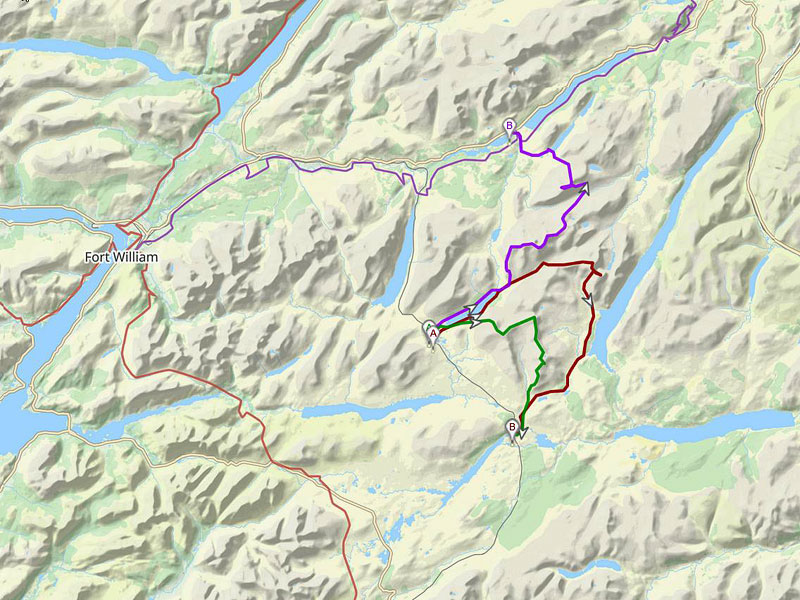
Starting point was Corrour station for all three (marker A, slightly misplaced for the Ben Alder route), and finishing point of the short route and Ben Alder one was Rannoch station (marker B).
Here is my journal entry for the penultimate ‘biggie’, with a few adaptations, though lacking the full styling and visual clarity of the original copy in MS Word…
Thu 23.5.91: BEINN EIBHINN – BEINN A' CHLACHAIR 20.5 miles; 1682m ascent, 1839m descent (Plotaroute figures)
>> Corrour stn – Loch Ossian (SE track) – Creagan an Amair – Mullach Coire nan Nead (921m) – Beinn Eibhinn (1100m) – Aonach Beag (1114m) – Geal Charn (1132m) – N ridge – An Lairig – (upper E corrie) – Beinn a' Chlachair (1087m) – spur & slope E of NW corrie – (track) – Lochan na h-Earba (SW end) – Luiblea – A86 <<
W: Cloudy (with drizzle on mountains) at first, but brightened during approaching & ascent; not in cloud till B. a' Cl summit area. Occasional light drizzle (thick patches around) p.m.; some sunny periods, but closing in from mid-p.m.; wind very light – moderate-fresh NW; rather warm.T: start 8.17 – B. Eibhinn 11.30 (lunch) – B. a' Chlachair 3.0 (eat) – end 5.25. TT 9:08.
G: B: Scarpa Alp, 45 broad. C: shorts; t-s.
M: ** R. ankle: complained ominously with use immediately after leg-through-snow on Geal Charn, but eased off. ** L. knee: slight cartilage ligament twingeing during upper pt final steep ascent (only).
Comments: Weather just adequate, but not good enough for the photographic record that I really wanted. On the road at the end, although it wasn't one of the busiest roads I've known, there was much more traffic than I was used to (but then my previous experience was in April), and within 10 minutes I got a lift to Spean Bridge, from where I got a lift almost immediately, arriving back at Perth Place at 6.30 — actually earlier than usual!
Yes, that one worked out, with no problems. The deep defile I had to cross for Beinn a' Chlachair meant a rather punishing long steep pull up the latter, but every bit worthwhile, and, after a summit eating stop (tremendous, breathtaking viewpoint!), I joyfully romped down various snowpatches to speed the easy descent — and of course for the sheer fun of doing that. That in itself was a wonderful major walk, well worth repeating on future Highlands visits.
Come the last day of my stay, 27 May 1991, with a suitable weather forecast, that was my final chance to attempt Ben Alder that time round. As I'd done for the ‘dress rehearsal’ walk, I'd arranged with my host for a very early breakfast and a taxi hire down to Fort William station, this time loaded with packed lunch and second lunch, for it was clear that this would be physically challenging for me. For this walk, in case it worked out, the second 'lunch’ was full-size. — important, for I'd always had an inefficient digestion / metabolism and readily started getting hypoglycaemic if not eating plenty on a mountain day.
Actually, it was a funny thing, but because of the need to keep to as fast a speed as I could sensibly manage without causing premature fatigue and likely injuries, my mind was naturally focused more on the practical details of where I was and what I was doing, for my own very survival, and so much less focused on the inner music this time, even though it was present in the background and became more prominent here and there. In any case this whole experience did in some way seem to put a meaningful ‘seal’ on what I'd already absorbed from my other Rannoch Moor walks.
I was able to walk with good speed in the approach, because I was on an estate track for the length of Loch Ossian, so I really hoofed it then. Thereafter, it was peat-hag terrain beside the Uisge Labhair stream, but an informal track through all that enabled me to wind about a bit to mostly avoid the fatiguing ups and downs across the hags.
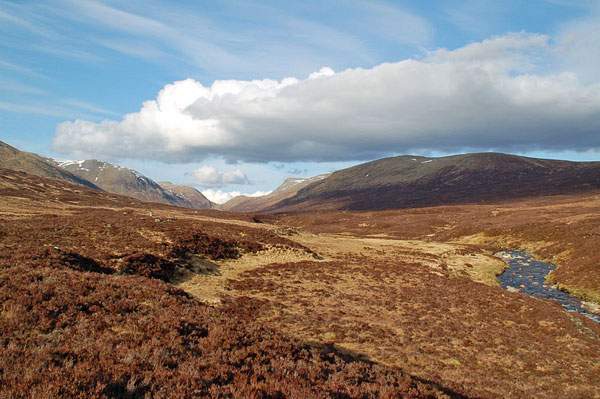
Soon after leaving Loch Ossian behind, still making good speed towards Ben Alder, the latter showing as the highest shoulder visible to right of the Bealach Dubh pass.
The Beinn Eibhinn group is on the left of the pass.
Please note that this is not my photo, but the author is unknown, which is why I can't credit it; I downloaded it in 2008/9 from a source of supposedly free non-commercial use images, so I'm assuming that it's okay to use it here.
Here's my journal account — sadly far too brief to do justice (in subsequent years my journal entries became more detailed), but at least it gives a small idea. I retrospectively added to the almost nonexistent Comments section, using some notes I'd written at the time in a report on that walk, to email to a friend, but that still misses a whole lot. Note how on the night immediately preceding this adventure, I was feeling close to abandoning the whole crazy notion on account of the risks I understood I'd be taking.
Bank Holiday Mon 27.5.91: BEN ALDER 22.5 miles; 1083m ascent, 1190m descent (Plotaroute figures)
>> Corrour stn – Loch Ossian (NW track) – Uisge Labhair track – (W spur) – Ben Alder (1148m) – Bealach Breabag – Sron Coire na h-Iolaire (955m) – \\ – Bealach Breabag – Benalder Cottage – Cam Chriochan bridge – (top edge plantation on flank of Beinn Pharlagain) – Lochan Sron Smeur – (track & rd, cutting off corner) – Rannoch stn <<
W: Cloudy; drizzling during later pt approach; cloud gradually lifting & breaking, – increasing sunny periods p.m.; wind light-moderate N; – warm p.m.T: Start 8.17 – (turn off track for B. Alder) 10.40 – summit 11.50 (lunch) – (returned to Bealach Breabag) 2.0+ – Cam Chriochan bridge 3.30 (eat) – Lochan Sron Smeur (W end) 5.20 (eat) – end 6.25 (54 min before train due). TT 10:08.
G: B: Scarpa Alp, 46. C: shorts; t-s.
M: ** R. foot: ball of big toe sometimes slightly painful. ** Miscellaneous: Fatigued at end, but not excessively so.
Comments: Spent much of the small hours worrying about this one, telling myself I'd bitten off more than I could chew in the time, and thinking up all sorts of excuses not to do it! After all, there were so many superb mountain walks that looked as though they weren't going to get done this time, and the Ben Alder walk was more of a moorland than mountain walk.
Fate has willed it
, my mind darkly muttered as my alarm sounded at 5.30 a.m.: I wasn't
really going to cancel my early taxi hire to the station and announce a chickening out from
something I'd planned for the best part of a year. In the event I was really chuffed at my bang-on
planning and scheduling for the walk, as the timings in the basic info show.
Actually, as my log entries were written for myself only, I took ‘as read’ certain pertinent points and didn't include them here. Here, as implied earlier on, the act of setting-out for this adventure was not in itself a very committing act. During the whole route right up to Ben Alder summit I had closely in mind the various options for shortening / abandoning the walk — which options of course thinned out as I continued.
Even on that summit, retracing to Corrour station would be a little shorter and definitely less fatiguing than the continuation to Rannoch station, and I was virtually poised to take that option right there in the event of my identifying any material contra-indication for continuing onward.
Thus, the real big frisson of commitment was there on the summit once I'd finished my lunch, but at least with any fear aspect much tempered by how smoothly I'd managed so far, and of course my great familiarity with boggy moorland terrain.
Also, as I was much used to on Dartmoor, I was not at all doctrinaire in following any specific
route. ‘Pragmatism’ could well replace Andrew as my middle name! On the rough stuff I was
constantly on lookout for easier lines, and I did find quite a few. Yes, I'm not just a funny face!
On Ben Alder, I sussed that I had time to get to the neighbouring hump (Sron Coire na h-Iolaire) for views of Ben Alder's cliffs, but that it would be too tight for time if I went on to Beinn Bheoil itself. I turned out to be precisely right. As it was I had 54 min to spare at Rannoch station. That may seem unnecessarily early, but in view of the length of the walk, difficulty of the terrain and variety of unknowns along the way, I wouldn't want much less than an hour's 'slack' in my schedule, and particularly first time along the route was no time to take advantage of such slack except in emergency. At least now I have timings for the main sections of the route.
It being a bank holiday, quite a number of people were starting to converge on Ben Alder summit once I'd got there, but I was the odd one out, the others all having overnighted at nearby spots. When I said I'd just walked from Corrour, several people independently seemed at first surprisingly unimpressed — until I got it across to them that I meant Corrour station, from the early Glasgow train, and not Corrour Lodge, which is significantly closer. Then there were some blinks and exclamations of surprise, followed by various notes of doubt and crossed fingers when I said where and when I planned to finish the walk.
The extensiveness of the Ben Alder plateau was a wonder to behold, and also made it an unforgiving place to be in any cold wind, and super-challenging for navigation in the cloud, especially with its broad spurs in northerly directions. However, I wasn't in the cloud, and the little wall by the trig point gave shelter from the chilling breeze for my early lunch stop. Apart from the rather tricky steep descent into the Bealach Breabag pass, for me this mountain was pretty easy walking, with no challenging gradients, the descent towards Benalder Cottage close to Loch Ericht being mostly grassy, as I remember — of course with rocks and indeed some slabs to avoid.
There's no space here sensibly to recount the various beautiful and atmospheric points along the way, but in general terms, the going was rough boggy moorland for a while, following rather inland the shoreline of Loch Ericht's southern end. There followed a much-needed eating stop by the Cam Chriochan bridge, beyond which I parted company with the loch and was now faced with a few miles of rough boggy moorland to cross.
However, to my surprise, my going was almost at once eased by a broad unofficial tractor ‘track’ on that terrain leading obliquely across the hard-going section to the other side, along the base of Beinn Pharlagain's slopes. Very soon once I was on that vague track, I just had to stop to take a photo that in some way had the feeling of ‘saying it all’ about that walk-off. I had to get down low (maybe I even knelt), but there was this elongate small pool in a drainage streamlet winding its way through this boggy expanse, and from this viewpoint, there was the south end of Ben Alder, perfectly mirrored in that pool, with the water surface glassy in its stillness. The photo came out fine, and felt in some way to be iconic. (Why isn't it shown here? — I explain a little further below…)
I did get a bit of hard-going very tussocky tall grass once on the far side of that boggy area, but then I was on the major track heading for the Loch Rannoch to Rannoch station road. At a particular point I branched off right to cross a stream and cut off a big corner, and then it was a brief road plod to the station, elated at what I'd come-off with — not just the route but the accuracy of my timing estimates, and of course that special Rannoch Moor ‘atmosphere’ —, but deeply frustrated that during my best-part-of-hour wait there I had no-one (at least, appropriate) with whom to share about what this naughty monkey had just got up to.
Follow-up — the anguish of having to give up hiking — but then…
In my May 1992 Fort William visit, the year following those two corker hikes, I gave other routes my attention, but also was getting some physical issues making things a bit more difficult, though still got a fair number of my classic routes walked.
However, as the year went on, neck pain became an increasing issue, especially on any day
following a major hike. My execrable GP of that time abruptly told me to stand up, now bend your
head this way, now that way — No, there's nothing wrong with your neck: just wear and tear. You'll
just have to live with it!
. It was pretty standard for him to make out, in one way or another,
that I was just a timewasting hypochondriac; one choice earlier occasion was when, as I entered his
surgery, he looked up at me from his chair and, before I could utter a word, abruptly declared,
No, you haven't got cancer!
— Nice guy!
I tried a private physiotherapist, and at least she pooh-poohed the doctor's totally unhelpful and unprofessional response, and talked of correcting my posture, and recommended McKenzie exercises and use of a neck roll for when sitting or lying. That, however, seemed if anything, to be compounding the problem.
An NHS physiotherapist talked of muscular tension being the real problem (which at least made sense, and indeed was the real trouble), and gave me a few brief sessions of traction, which, as I expected, made no lasting difference. — After all, no-one yet was pointing me to addressing the cause of that tension.
I managed to get a locum doctor at the practice to refer me for a neck X-ray, and the report
ominously declared Advanced cervical spondylosis
. I was getting scared. — Indeed getting
more so by the day, for by then I could feel and hear neck vertebrae slopping around on each other
(even with some definite rubbing of bone against bone) even as I was walking about town and
frantically holding a ‘correct’ head / neck posture all the more tightly as I attempted to bring
those vertebrae to heel.
It was nearly Christmas, and, after another hike that left me with my ‘killing’ neck pain again the following day, I reluctantly decided that that last hike had to be my last. I was clearly on the verge of being really crippled by this issue.
At that point, in town I encountered an acquaintance who I'd not seen for a while, who routinely
asked how I was, and I announced my reluctant decision and the reason for it. — Upon which he
perked-up and said I know what you want: the Alexander Technique!
He explained very briefly about it, saying he uses it himself as a piano teacher, and it's the real answer. He told me of a centre in Exeter where there were two AT teachers, and suggested I have a look for books about it, to help me decide whether to fork out for lessons.
That immediately stood out as something different from the usual crass unsolicited advice I got from people over all sorts of matters, because a year or so earlier I'd been to an osteopath about my already developing neck trouble, and he himself had recommended the AT as the most effective solution, but at that time I had no money for a course of lessons in that, so had set that idea aside and then forgotten about it. As it happened, at this point I'd just recently got a £2,000 legal settlement over a commissioned Dartmoor natural history book that I'd produced all the copy for, but which then got scuppered by the publisher's owners closing down that aspect of their business.
I did browse for an AT book that really gave basic understanding of that method, and found one that stood out from the others, which latter were really more aimed at persuading people to have AT lessons rather than giving one a proper understanding that one could use at home. Within the day I went to that centre to book a course of lessons, because that book made complete sense of why I was having neck trouble, and why it was getting still worse because of (not in spite of) my attempts to hold ‘correct posture’. (!)
It was a few weeks before I could have my first lesson, but, me being me, I immediately set-to applying what I'd learnt from the book, as far as I could without guidance from an AT teacher, and did indeed notice a telling change occurring even though neck pain elimination was some way off. I very soon started hiking again, after no more than a few missed opportunity days. At first I was still getting a fair amount of neck pain afterwards, but even then I had a deep-sourced understanding that real positive change was occurring, and, importantly, I was less troubled by what pain there was, so no longer needed to be put off from hiking.
Within weeks the neck pain was reduced and neck function (co-ordination and alignment) was clearly getting better, and my hikes were no longer aggravating the neck. Indeed, the AT gave me a much better, more efficient mode of walking, which made the hikes altogether less hard-going.
Naturally, the weasel-thought started coming up: I'll be at Fort William again this May after all; let's walk the Ben Alder route again, even including Beinn Bheoil, as a token of triumph over what had caused me to transiently give up hiking altogether!
Repeat performances, maybe?
…And did it happen? — Yes, indeed, on 26 May 1993 (at age 51), including Beinn Bheoil, which added only about 1.5 mile to the route, but really didn't seem to have such interesting views, so I wouldn't include it again, not being a ‘Munro-bagger’ (an idiotic ‘sheep’ pursuit!). However, that in no way spoiled the great walk!
I note also from my journal, that on my outward journey to Fort William that year, that was the first time I'd chosen to abandon the West Highland Line part of the rail journey in favour of taking a local train from Glasgow to Balloch (by south end of Loch Lomond), with a 10-minute walk across to the main road, and then hitch-hiking the remaining part to Fort William, arriving there well in advance of scheduled arrival time of my would-be train there.
No doubt the positive effects of the AT had included my getting more adventurous about the transport, and generally becoming (still) less inclined to get stuck in ruts. In fact I chose that same hitch-hiking option from then onwards, up to my final visit there in 1999. I so much enjoyed that additional sense of freedom and adventure, even though I also missed the West Highland Railway ride because that was a beautiful route in itself, which departs from the road route for a wonderful excursion through Rannoch Moor.
In addition, I walked the Ben Alder route again on 24 May 1994, this time without Beinn Bheoil. I wasn't going to include details of that here, but then decided to after all because from 1994 onwards I wrote more descriptively in my journal entries, so the following makes up for the terse and very deficient one for my first Ben Alder walk.
Tue 24.5.94: BEN ALDER 22.5 miles; 1083m ascent, 1190m descent (Plotaroute figures)
>> Corrour stn – Loch Ossian (SE track) – Uisge Labhair track – (W spur) – Ben Alder (1148m) – Bealach Breabag – (N shoulder) – Sron Coire na h-Iolaire (955m) – \\ – Bealach Breabag – Benalder Cottage – Cam Chriochan bridge – (top edge plantation on flank of Beinn Pharlagain) – Lochan Sron Smeur – (track & rd, cutting off corner) – Rannoch stn <<
W: Dull at first (sunny in FW), but cloud slowly broke & lifted during approach; final little bit of cloud came across summit plateau as I neared summit cairn; then sunny periods – sunny early p.m., then much stratocumulus cumulogenitus with few brief sunny periods; few light spots rain late p.m.; wind light-moderate ENE; rather cool.
T: 8.18 – turn-up from Uisge Labhair 10.42 – summit 12.01 – Bealach Breabag (2) 2.01 – Cam Chriochan 3.46 (eat) – Lochan Sron Smeur (far end) 5.30 – end 6.31. TT 10:13.
G: B: Scarpa Alp, 46 4. C: t-shirt (except approach and summit–col).
M: ** Feet: aching & sore. ** R. ankle: inner malleolus getting a little tender late in walk.
Comments: This was a bit crazy*, deciding on Ben Alder today with my feet & legs so unrested, but the weather forecast seemed right — though this morning's early forecasts indicated that rain in S. Scotland was getting closer. Although it was a sunny start in Fort William, the form of a few small patches of low cloud had an unsettled look.
* Not kidding when I wrote ‘crazy’! The previous day I'd walked another of my classic big walks, albeit much more accessible, and relatively easy walking — over Beinn Dorain, Beinn an Dothaidh, Beinn Achaladair, and over Beinn a' Chreachain before returning to the A82 road for hitch-hike back to Fort William — about 16 miles and some 1827m of ascent, with my feet already sore and legs none-too fresh at the beginning of that, after big hard walks on both the two days before!
However, that speaks volumes for the easier walking mode that I'd gained when I took up the Alexander Technique, so although it looks crazy, actually I did intuitively have a very good idea of what I could get away with.
Nominal 6.30 (actually 6.20) breakfast, and May drove me to station for 7.30 Glasgow train (return ticket to Rannoch £7.70). As the train proceeded, I became increasingly dubious about this venture, for from Glen Spean I saw most high mountain tops clipped by cloud. As the train turned southwards along Loch Treig it became apparent that the whole of Rannoch Moor was under a cloud sheet that had devoured all high mountain tops. From Corrour I could see a slight brightness in the cloud around Ben Alder's Bealach Dubh, but that wasn't necessarily very encouraging, for the mountains there could often cause slight breaks in the cloud over the pass without any general tendency for clearance.
Anyway I set out on the track alongside Loch Ossian, with an open mind about what I'd do if the weather didn't improve markedly; if necessary I could repeat last year's Loch Pattack walk, for example. In the event, that bright area around the Bealach Dubh very gradually expanded, the cloud slowly lifting off the mountains. This was a slow process, and it wasn't till I was getting quite close to Ben Alder that its top was properly clear of cloud, bar the odd passing tuft.
Turned off from the Uisge Labhair track a little sooner than previously, where I found a suitable shallow to cross. Then, rather than fight through a lot of peat hags, consistently followed the grassy borders of various streams and runnels. This made remarkably light work of nominally very rough and tedious terrain. After the pretty brief main steep ascent it was the long plod up the great summit plateau. Fortunately, with only a little deviation I was able to avoid most of the extensive snow, which wasn't sloping the right way for me. As I neared the summit cairn a final tuft of cloud slowly drifted across, almost obscuring my direction for a moment, and then I was there and it was clear — except that much of Rannoch Moor was still a murky mess disappearing under low cloud.
Lunched mostly in sunshine, sheltered by summit cairn from light but very cold wind. I appeared to have the mountain for myself. And what a sense of remoteness! Although this mountain could hardly win many Brownie points for shapeliness, the enormous extent and sweep of its 2 broad N-running ridges gave this top a glorious sense of remoteness and aloofness. Beyond, the distant Cairngorms were clear.
Followed the cliff line round towards the Bealach Breabag as before, here and there walking along cliff-top snow to avoid rocky stretches. Then, during tricky steep descent towards Bealach Breabag, met 4 men coming up. They were going to Corrour station after the main summit, and expected to get on my train this evening. By the time I'd got down into the col, the cloud had melted away from Rannoch Moor and it was quite sunny with only scattered small tufts of cloud.
After Benalder Cottage and the strange footbridge close by, I soon lost the track as previously. A little further along I edged upwards (R.) as I ploughed through the trackless moorland, to see if I might regain the track before where it restarts on map. Indeed I did find it, though it was often faint and several times I briefly lost it. Although easier than ploughing through trackless moorland it undulated quite a bit, and my legs were really flagging on the little rises.
Felt just about all-in by the time I was approaching Cam Chriochan bridge, my scheduled afternoon eating spot. Although cumulus clouds were now doing their old trick, spreading out over the sky, I was still getting some warm sunshine to make this eating break very pleasant indeed — though eating so many of the filled rolls was already getting a little tedious.
When I started off again I was clearly much revived, which was just as well, for I knew there was a lot of work to do yet. By now it was mostly cloudy with the rapidly-formed stratocumulus and I even felt a very occasional few spots of rain. As before I followed the tractor tracks on the soft boggy moorland, the dry conditions making it a trifle easier going than previously. Looking at forestry enclosure on flank of Beinn Pharlagain, I came to conclusion that there's no point in even starting to ascend this slope until I meet the fence.
On the very rough moorland a little beyond Lochan Sron Smeur I actually found a somewhat indistinct impromptu motor track in the peat, which led me relatively easily to the main track.
At Rannoch stn I had a full 2½ hrs to wait (the evening train was now scheduled later than previous years). I was in pretty good shelter on a station seat (all rooms were closed), & ate my evening meal (another packed ‘lunch’) there. Despite May's best efforts with the filled rolls, by now I was finding them tedious and difficult to eat, but somehow got through them all. Shelter or no shelter, I was quickly getting cold as clouds were resolutely denying me any sunshine — yet I was pretty fatigued and didn't want to go walking around either. So just sat here, shivering, bored as hell, with nobody to talk with.
One mystifying observation while sitting there was a strange bird call. The bird kept flying from near this end of Loch Laidon, some hundred metres or so to my R., then returning. While flying it uttered frequent inconspicuous little quacky chirps, which wouldn't have attracted attention, but, especially at the ends of travel, it uttered a weirdly low-pitched collywobbly moan, which sounded quite threatening.
Yet I never saw any bird to associate with the sound, despite the scores of times it flew to and fro there, identifying itself with these funny sounds. The distinctive sound was so low-pitched, it must have been produced by a big bird, but I didn't see a bird of any size corresponding with the movements of the calls.
The train arrived 10 min early, to my relief, and left 2 min early. At Corrour indeed the group of 4 who I'd met earlier got on and we talked a bit till they got out at Roy Bridge. Apparently they'd got to Corrour only an hour before the train came.
At Fort William, took taxi (£2.10) to Perth Place, arr 10.12. Apparently Mike had set out to pick me up but hadn't allowed for train being early. As last year, May provided soup & rolls, which was a really nice finish. And as for tomorrow — it would have to be at least a very easy day; so said my feet!
Established many years later that the mysterious bird sound was ‘drumming’ of a snipe (which I portrayed musically in a telling episode in my Symphony 4, final movement).
Yes, hearing that mysterious bird sound, and for so long, so it was firmly imprinted in my mind, was a priceless final gift to me from that memorable walk.
Where all those internal barrier dissolutions were leading…
It was just the following year (1995) that at last I was able to break out into composing proper ‘opus-number’ music works, and by the end of the year I was finishing-off my Symphony 4 (Highland Wilderness), whose hauntingly atmospheric final movement contains an episode using instrumental impersonations of that strange snipe sound, which latter at that time was still unidentified.
For more about how I came at last to get properly composing my public works, and a whole lot more about my modus operandi in the composition work, and penetrating new insights into the music composition process generally, please see Musical influences on Philip Goddard's music & literary works.
I strongly recommend a thorough read of the notes about the symphony on that page, because they go into an explanation of the source(s) of that strange Rannoch Moor music, which I used in that symphony, even though the cuckoos that commence the symphony are from the Western Highlands, not Rannoch Moor, where latter I don't remember ever hearing a cuckoo. (Hint: just maybe something to do with ghosts, of all things…?)
Here's a hint of the atmosphere of the final movement of that symphony — the movement's prelude, adapted as a standalone work by means of my suddenly terminating it with a thick, elemental and emotive chord, leaving that quiet underpinning held low tone hanging over the abyss. At that point in the symphony that chord doesn't occur, but the main ‘action’ starts. — Rannoch Moor Prelude…
If, however, you want to hear the deeply affecting snipe-drumming impersonation episode, you'd need to listen to the whole movement — or much better of course, the whole symphony.
My ultimate achievement — the ‘pinnacle of all pinnacles’?
No, not music, nor mountains (those were mere sideshows, but all having been important steps along the way)! Yes, there was something much bigger that I was eventually to stumble into, thanks to all those earlier stages — the ‘pinnacle of all pinnacles’, which virtually everyone was (and largely still is) too dysfunctional even to consider as a possibility.
See Project ‘Fix the Human Condition’. That is why both internal directives and force of circumstances were repeatedly pointing me in directions to powerfully cultivate my independence of mind, self-reliance and self-command, and freedom from all belief, orthodoxies and traces of ‘sheepism’.
My solo mountaingoing was thus a major step in my preparation for possibly succeeding in a life task of unprecedented and crucial importance for all Humanity throughout all of ‘Existence’.
That was not just a matter of being enabled to keep clear of acquiescence in people's, and Society's, pressures to conform to their limiting mindsets, but also to withstand the destruction attempts* that were expected to come my way, as indeed they did, and to be able to examine the mechanisms of those destruction attempts, and pass all new insights through to deeper consciousness (DC) in the most helpful conceptual form, so that DC itself could then at long last go about rectifying the related misconfigurations in consciousness at the deepest and universal level.
* To get some idea of how convoluted and, at the time, confusing those destruction attempts were, see:
- The ‘forces of darkness’ (‘astral beings’) — My own tough experiences, and the related page:
- My ‘astral beings’ — Now the scary bit: what I was really dealing with, in which I present my retrospective detective work that revealed that two particular named individuals — both ‘healers’ and so-called ‘lightworkers’ — appear to have been repeatedly attempting to assassinate me through setting up a series of psychic attack scenarios.
Now that those misconfigurations have allegedly been fixed, all new planetary civilizations would be different beyond the limited imaginations of almost everyone here on Earth, being based in rationality and objectivity rather than beliefs and straitjacketing traditions. They would therefore be without wars*, and with reasonable population control and respect for the environment, so prolonging their period of sustainability on their respective planets before they eventually need to leave, and would excel in all genuinely beneficial aspects of creativity.
* Actually that would probably be a mild overstatement, because humans free of the serious dysfunctions that characterize Humanity over the aeons till now would still have to learn to override and manage their ‘animal instincts’, which latter could give rise to some conflicts, but nothing to compare with the scale and persistence of conflicts we still see today.
I and certain companions-to-be on our next planet look forward to some tremendous joyful mountain hikes there, no longer haunted by ‘ghosts of the past’! No-one would reincarnate on Earth again, which latter needs a very long rest — hundreds of millions of years, to allow plate tectonics to renew usable natural resources.
Meanwhile, as they say —
